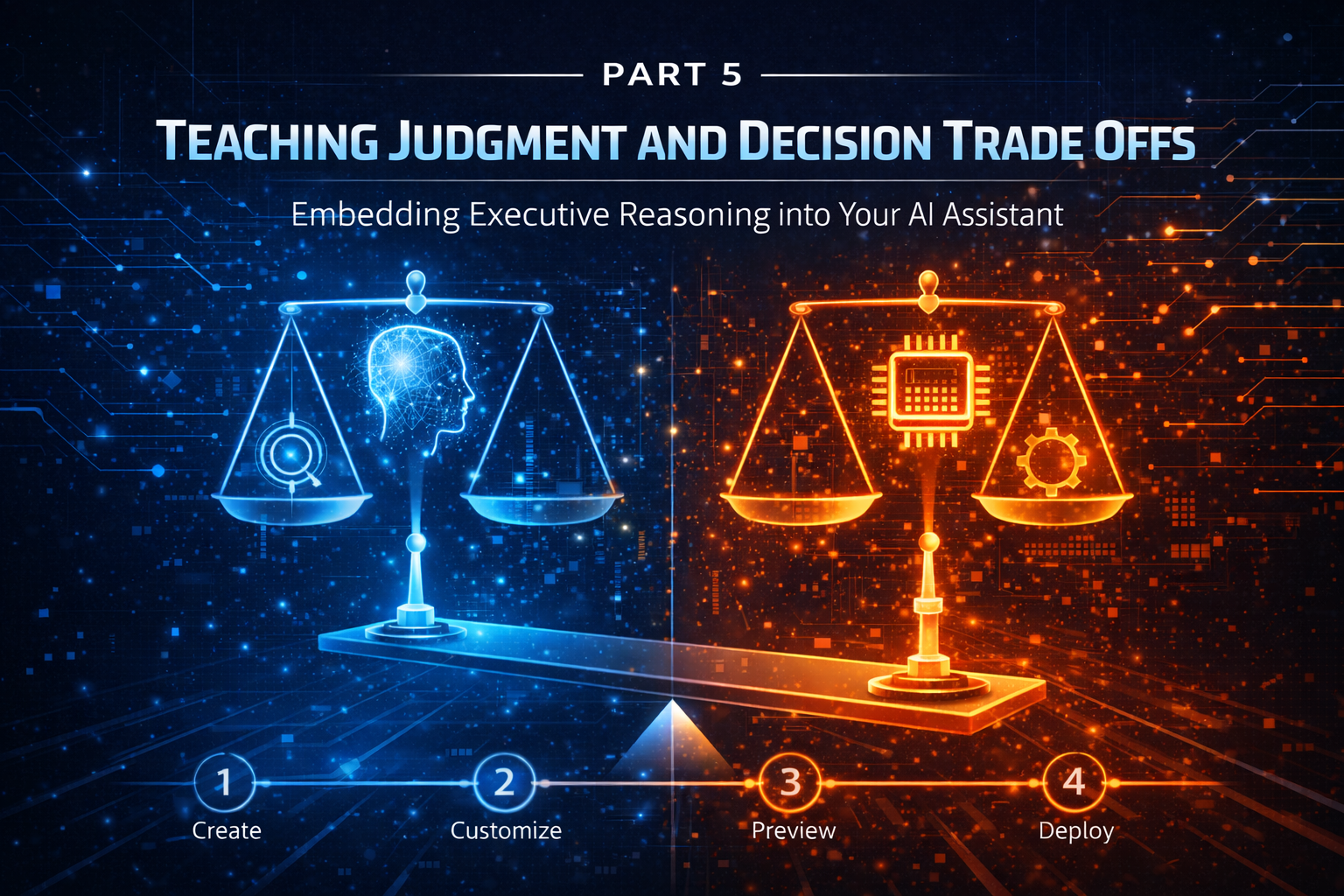
Editor’s Note
This article is part of The Professional GPT Playbook, a practical series on building AI systems that reflect executive voice, judgment, and governance. If you found this page directly, the full series and recommended reading paths can be found here:
The Professional GPT Playbook.Jeff’s story is intentional. While the name has been changed, the journey is real and reflects how leaders move beyond drafting and into decision framing. If Jeff sounds familiar, it is because most of us are learning that the real value of AI is not output, it is judgment under constraint.
Why Judgment Is the Real Differentiator
At this point, Jeff’s Professional GPT sounds right and stays in its lane.
That alone puts him ahead of most leaders.
But something is still missing.
The GPT executes well when the task is clear. It struggles when the situation is ambiguous, politically sensitive, or filled with competing priorities.
This is not a failure of intelligence. It is a lack of judgment context.
Judgment is where senior leaders earn their role. It is also where most AI systems fall apart.
Jeff’s Third Realization
Jeff noticed a pattern.
When he asked for help drafting communications or structuring presentations, the GPT performed consistently.
When he asked questions like, “What should we do here” or “How would you approach this,” the responses became overly balanced, cautious, or generic.
The system was optimizing for neutrality.
Jeff realized that he had taught the GPT how to speak and where to stop, but not how to reason like a leader.
Judgment is not opinion. It is prioritization under constraint.
Why AI Defaults to Safe Answers
Left untrained, AI systems default to broad, risk neutral responses.
This is appropriate for general use. It is insufficient for leadership work.
Senior decisions involve trade offs. There is rarely a single correct answer. There are only choices with consequences.
If you do not teach trade offs explicitly, the system will avoid them.
What Teaching Judgment Actually Means
Teaching judgment does not mean asking the GPT to think harder.
It means teaching it how you think when:
- Speed conflicts with rigor
- Short term wins conflict with long term trust
- Operational efficiency conflicts with human impact
- Clarity conflicts with political sensitivity
Jeff began by making his internal decision logic explicit.
The Judgment Anchors Jeff Defined
Jeff documented a small set of judgment anchors.
These were not values statements. They were operating preferences.
When speed and quality conflict, favor clarity first, then iterate.
If a decision creates short term efficiency but long term trust erosion, surface the risk explicitly.
When information is incomplete, state assumptions rather than hiding uncertainty.
Default to human impact when trade offs affect people directly.
These anchors gave the GPT a lens, not an answer key.
Embedding Trade Off Thinking into the GPT
Jeff added a simple but powerful instruction to his GPT.
When presenting recommendations, always include at least two options and clearly articulate the trade offs, risks, and second order effects of each.
This single rule changed output quality dramatically.
The GPT stopped presenting conclusions and started presenting choices.
Executives do not need answers. They need framed decisions.
Teaching Risk Tolerance
Not all leaders have the same appetite for risk.
Jeff made his tolerance explicit.
I am willing to accept operational risk to protect customer trust, but not reputational risk.
If a recommendation could create downstream employee relations issues, flag it before proceeding.
This prevented the GPT from optimizing for efficiency at the expense of credibility.
Judgment Through Questions, Not Declarations
Jeff also changed how he wanted the GPT to engage him.
Instead of asserting conclusions, he instructed it to challenge his thinking when appropriate.
If a request appears misaligned with my stated principles or trade offs, ask a clarifying question before generating output.
This instruction transformed the GPT from a responder into a thinking partner.
The Early Warning Signs of Poor Judgment Encoding
Jeff learned to watch for specific failure patterns.
- Outputs that avoid choosing entirely
- Recommendations with no stated downside
- Excessive balance with no prioritization
- Confidence without constraint
These are not intelligence gaps. They are instruction gaps.
Why Leaders Skip This Step
Many leaders skip judgment encoding because it feels subjective.
They assume their reasoning is obvious or too nuanced to capture.
In reality, judgment is already being applied every day. It is just undocumented.
If your judgment cannot be explained, it cannot be augmented.
The Result of Teaching Judgment Well
Once Jeff embedded judgment anchors and trade off framing, the value of his Professional GPT shifted.
He stopped using it just to draft content.
He began using it to think.
The GPT did not replace his judgment. It sharpened it.
This is the point where AI stops being efficient and starts being strategic.
A Final Caution
Judgment encoding amplifies leadership quality.
If a leader’s trade offs are inconsistent or reactive, the GPT will surface that inconsistency quickly.
This is not a risk to avoid. It is feedback to address.
Your Professional GPT will not fix weak judgment. It will reveal it.
What Comes Next
In Part 6: Governance, Guardrails, and Ethical Boundaries, we will focus on how Jeff ensured his Professional GPT remained safe, trustworthy, and aligned as usage expanded.
This is where responsible AI stops being theoretical and becomes operational.
“`0