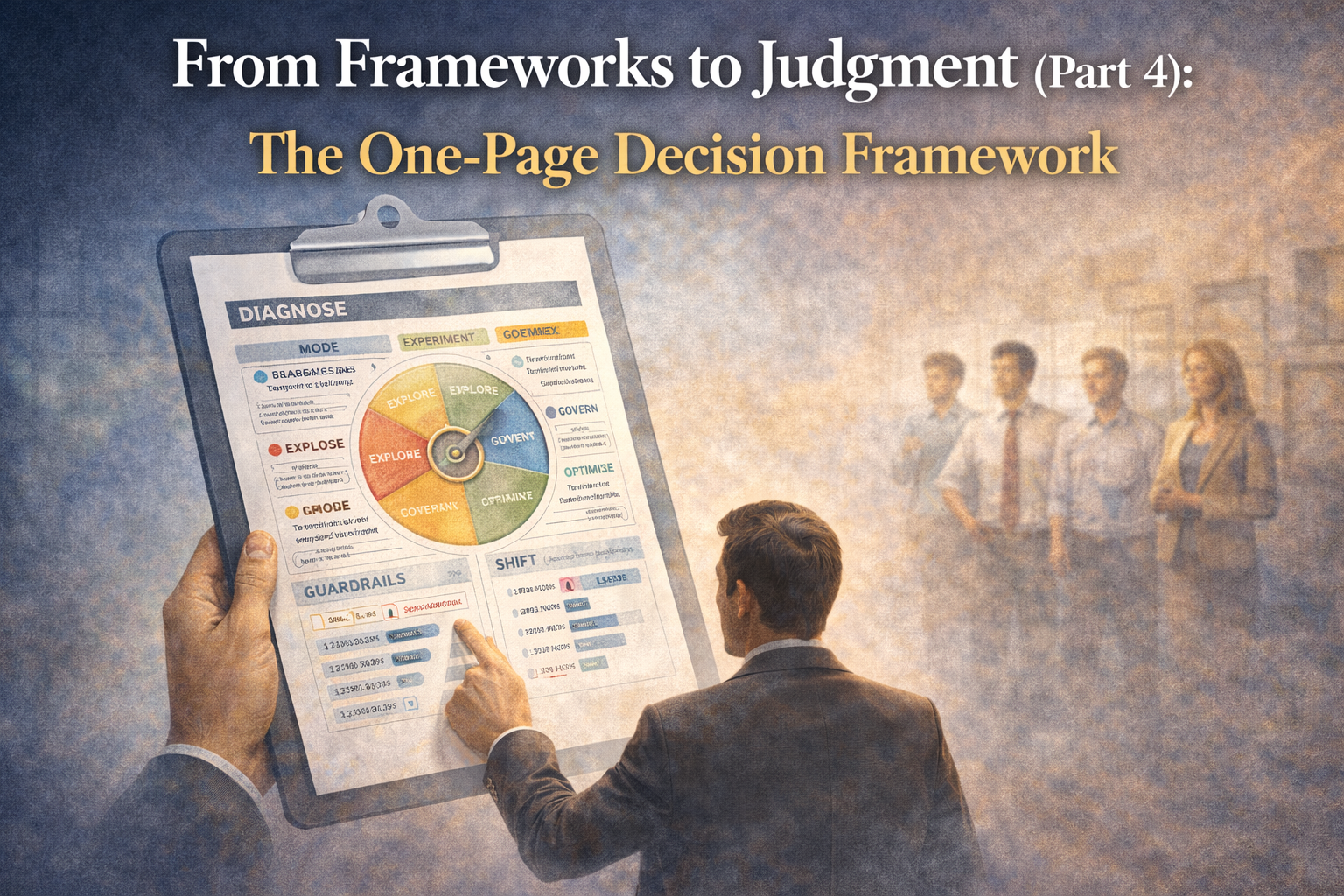
From Frameworks to Judgment (Part 4): The One Page Decision Framework
The goal of this series was not to compare frameworks. The goal was to make leadership judgment visible, so it can be practiced, scaled, and governed.
Editor’s Note
This article is part of a four-part series, From Frameworks to Judgment, on how leaders choose and apply methodologies based on the state of the work. If you arrived here directly, you can view the full series at angeloarezzi.com/from-frameworks-to-judgment.Jeff appears throughout the series as a composite senior leader, used to make explicit the decision logic experienced leaders already use intuitively but rarely articulate.
This framework is designed for senior leaders who need clear guidance, practical oversight, and repeatable success. It is intentionally simple because it must work in real meetings, under real pressure.
Core Principle
Methodologies are operating modes, not identities. Choose the mode before you choose the method.
Step 1, Diagnose the State of the Work
Before you choose a method, answer these questions honestly. If leaders skip this step, the organization defaults to preference and politics, not fit. Diagnostic question If yes If no Do we clearly understand the problem? Move toward delivery or improvement Start with exploration Do we know the right solution? Focus on execution discipline Expect learning and iteration Is risk high, or is visibility required? Add formal governance Keep lightweight controls Is the work repeatable and stable? Optimize and standardize Avoid premature optimization
Step 2, Select the Operating Mode
Each mode maps to a leadership intent. The methodologies are simply common tools that fit the mode. Operating mode Primary leadership question Methods that fit Explore Are we solving the right problem? Design Thinking Experiment What can we learn by doing? Agile delivery Govern How do we manage risk and alignment? PMP, project governance Optimize How do we stabilize and scale? Six Sigma, Lean
Callout
Most organizations fail by mixing modes. They govern during exploration. They explore during optimization. Then they call it complexity.
Step 3, Apply Guardrails Based on the Mode
Guardrails should change by mode. This is how leaders provide oversight without killing progress.
- Explore, prioritize discovery, define exit criteria, avoid premature metrics.
- Experiment, timebox work, set intent and constraints, use fast feedback loops.
- Govern, clarify decision rights, track risks, formalize escalations, ensure transparency.
- Optimize, stabilize inputs, define measurable outputs, assign process ownership, enforce discipline.
Step 4, Know When to Switch
Switching modes is not failure. It is leadership. These are the signals that tell you the system is in the wrong mode. Signal What it usually means Suggested shift Teams debate assumptions endlessly The problem is unclear Move back to Explore Teams deliver, outcomes lag Intent and measures are misaligned Reframe, then Experiment Risk exposure increases Complexity and dependency are rising Add Govern Performance plateaus Work is stable, improvement is needed Move into Optimize
Step 5, Invest in Practice, Not Just Training
This framework fails if leaders treat it like another course. The capability comes from practice.
Core Reminder
Training creates awareness. Certification creates confidence. Practice creates capability.
Why This Matters Even More in AI Enabled Operating Models
AI accelerates execution. It exposes weak problem framing. It amplifies poor governance decisions. If you choose the wrong mode, AI compounds the cost quickly. Leaders need a shared decision language that keeps speed aligned to intent.
Closing Thought
Leadership Principle
The best leaders are not loyal to methodologies. They are loyal to the state of the work.
If you want a simple way to start, use this framework in your next review meeting. Ask the team what mode they are in, what would cause a mode switch, and what guardrails leadership must provide to make that mode successful.
Previous: From Frameworks to Judgment (Part 3): How Leaders Actually Decide
Series: From Frameworks to Judgment