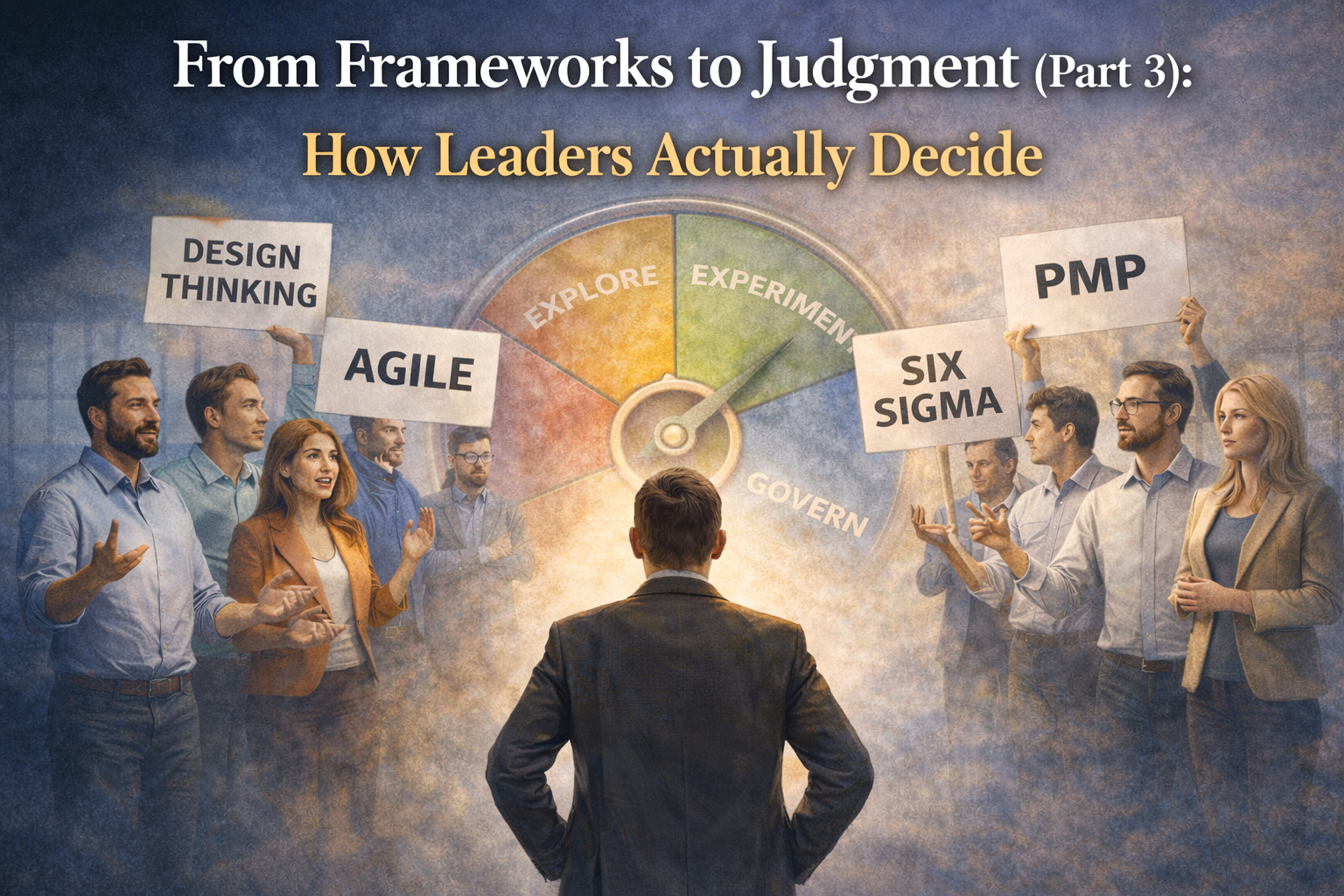
From Frameworks to Judgment (Part 3): How Leaders Actually Decide
Most leaders are not struggling because they lack a framework. They are struggling because the system is stuck in the wrong mode.
Editor’s Note
This article is part of a four-part series, From Frameworks to Judgment, on how leaders choose and apply methodologies based on the state of the work. If you arrived here directly, you can view the full series at angeloarezzi.com/from-frameworks-to-judgment.Jeff appears throughout the series as a composite senior leader, used to make explicit the decision logic experienced leaders already use intuitively but rarely articulate.
If Jeff sounds familiar, it is because most senior leaders eventually face the same set of pressures. Uneven performance, fatigued teams, competing methodologies, and a constant demand to deliver outcomes while the ground keeps shifting.
Jeff Walks In, Everyone Has a Favorite Method
Jeff is brought in to stabilize and modernize a complex operation. One team wants to run Design Thinking workshops. Another wants to belt the whole organization with Six Sigma. Delivery teams want Agile freedom. The PMO wants tighter governance.
Jeff does not start by choosing a framework. He starts by diagnosing the state of the work.
Callout
Jeff does not ask which methodology is best. He asks what mode this system needs right now.
When Jeff Uses Design Thinking
Jeff reaches for Design Thinking only when he believes the organization is solving the wrong problem.
He hears debates about metrics and ownership, but no one can articulate what success feels like for the people on the receiving end of the work. Rather than optimize prematurely, Jeff slows things down. He uses Design Thinking to surface assumptions, reframe the problem in human terms, and create shared understanding across silos.
Then he shuts it down. Not because it failed, but because it did its job.
When Jeff Uses Agile
Once direction is clear but uncertainty remains, Jeff shifts into Agile delivery. He uses Agile when learning must happen through action and waiting for certainty would create more risk.
Jeff makes one point non negotiable. Agile does not mean open ended exploration. It means constrained learning. He sets intent, priorities, and guardrails, then expects teams to iterate inside those boundaries.
Callout
Jeff watches outcomes, not motion. If progress stalls, he revisits intent before he changes process.
When Jeff Uses PMP Style Governance
As the work scales, cross functional dependency rises and risk becomes real. That is when Jeff introduces traditional project governance.
He uses PMP style discipline to make decisions explicit, risks visible, and accountability clear. He does not use governance to freeze learning. He uses governance to coordinate complexity and protect the organization from avoidable surprises.
When Jeff Uses Six Sigma and Lean
Only after the work is understood and stable does Jeff bring in Six Sigma and Lean. He applies them when variability becomes the enemy and scale is the goal.
Lean becomes Jeff’s lens across silos. Value streams matter more than org charts. Queues, handoffs, and rework become visible, and that is where the real improvements live.
Jeff’s Actual Decision Logic
Jeff’s logic is simple, and that is why it works.
- If the problem is unclear, he explores.
- If the path is unclear, he experiments.
- If the risk is high, he governs.
- If the work is stable, he optimizes.
What Jeff Never Does
- He never treats certification as proof of readiness.
- He never applies a method longer than it is useful.
- He never confuses activity with progress.
- He never lets a framework replace leadership judgment.
Callout
Jeff expects leaders to be fluent, not dogmatic. Capable, not credential dependent.
Where We Go Next
In Part 4, we turn Jeff’s implicit decision logic into a one page framework leaders can use in reviews, planning, escalations, and governance. It is designed to be teachable, repeatable, and practical.
Next: From Frameworks to Judgment (Part 4): The One Page Decision Framework
Previous: From Frameworks to Judgment (Part 2): What Each Methodology Is Actually For
Series: From Frameworks to Judgment