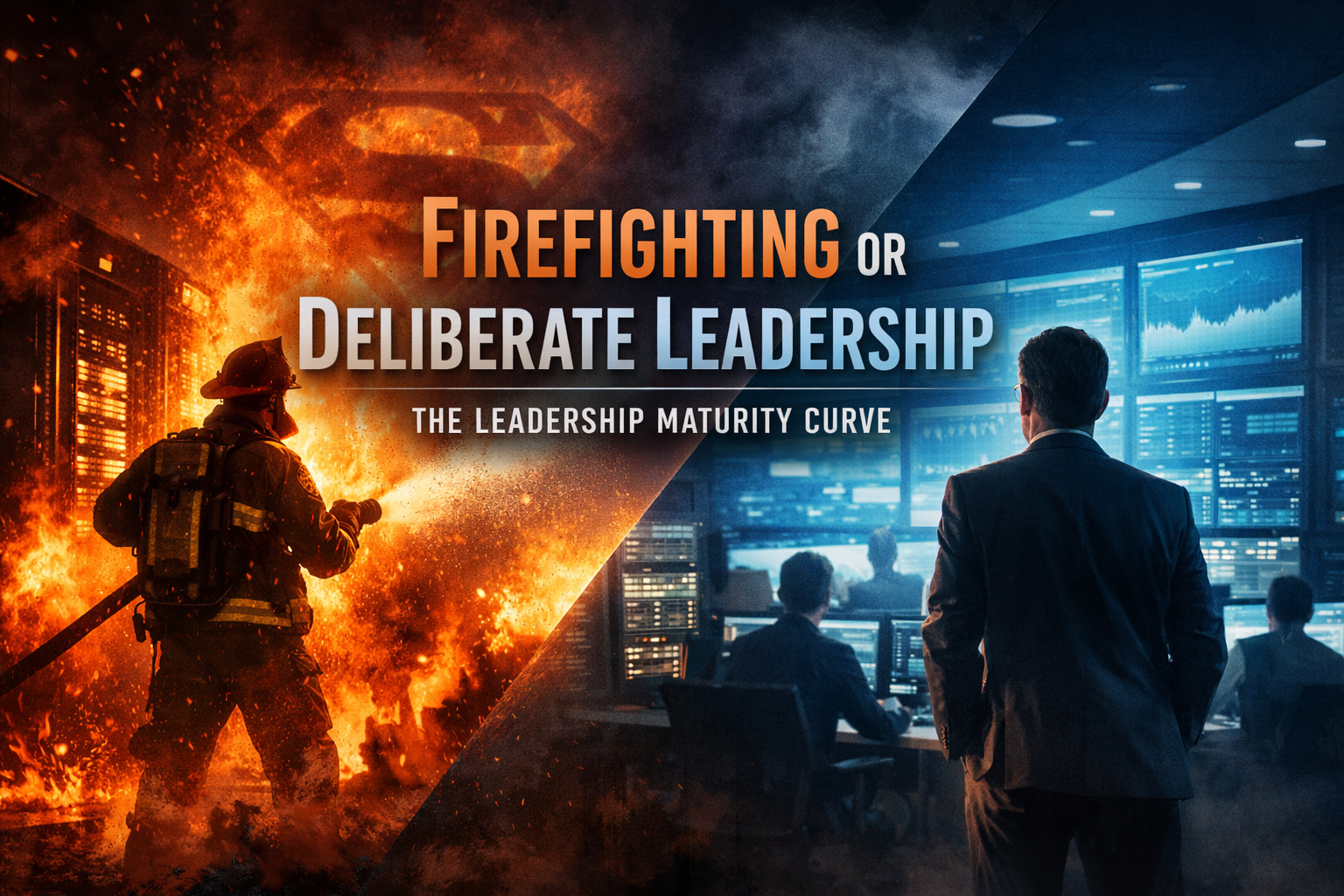
Firefighting or Deliberate Leadership: The Leadership Maturity Curve
Editor’s Note
Jeff is a composite leader I use across this series to illustrate real operational inflection points. If this is your first time here, this article connects directly to the operating system thinking behind:This piece focuses on the human inflection point that often precedes system redesign.
Early in my leadership career, I built my brand as the firefighter.
In my second formal leadership role, I moved from supervising an outreach team to managing a Tier 3 engineering organization. I carried the company emergency phone. I was always first to answer. When disaster struck, I executed.
In one instance, a COO told me, “You are our Superman.”
I was pulled into major deals. Escalations came directly to me. My identity was cemented, I was the fixer.
Then one night, that identity was tested.
An incident hit. A real one. The kind that threatens reputation, revenue, and long term trust.
For three straight days, I worked 22 hour shifts alongside my team. Conference calls ran continuously. Tickets piled up. Decisions were urgent. I was in every room, on every call, in every thread.
And then I began to crack.
On status calls, I struggled to focus. I had to ask for questions to be repeated. For the first time in my career, I was asked to take a break.
I was devastated. Exhausted. Embarrassed.
It was Thanksgiving.
I was upstairs firefighting while my family sat downstairs at the dinner table.
That moment could have broken me.
Instead, it defined me.
The Inflection Point
My mentor said something that changed everything:
“You need to lead here, not be Superman. You can be good at most things, or great as a leader. You have to decide.”
That statement reframed the problem.
I was not failing because I lacked capability.
I was failing because I was leading through brute force instead of deliberate leadership.
Over the following weeks, I dissected the incident:
- Where were the breaks in response?
- What communication chains failed?
- Where did decision rights blur?
- What patterns did we miss?
- What should have been pre designed?
I stopped studying the fire.
I started studying how we were operating.
The Test
Soon after, another major outage hit.
I felt the old instinct surge, jump in, take the keyboard, control everything.
Instead, I paused.
I became the conductor.
Clear roles.
Defined swim lanes.
Escalation logic aligned in advance.
Executive questions anticipated before they were asked.
We executed faster than when I had been hands on.
But more importantly, I was composed during status calls. I was proactive, not reactive. I anticipated the concerns of the C Suite and already had structured answers.
The Superman logo was still intact.
But this time, I was supporting the process and driving results with less friction.
What they saw was not a firefighter.
They saw deliberate leadership.