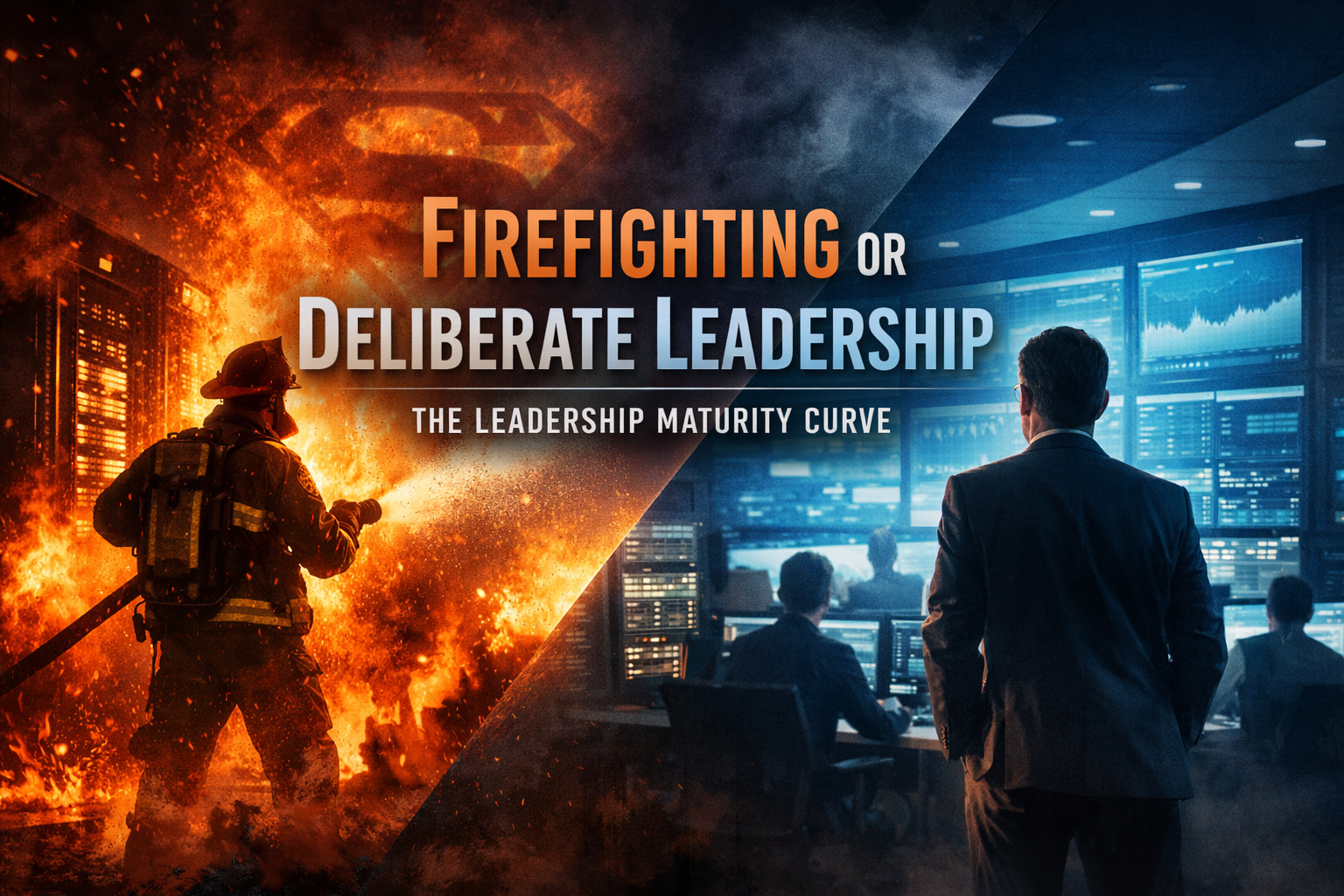
The Jeff Moment
Jeff runs operations in a scaling SaaS company.
He is known for responsiveness. His Slack lights up and he responds within seconds. Escalations route directly to him. The CEO trusts him because he always jumps in.
His team calls him “the closer.”
But Jeff’s calendar is full of incident bridges.
Coaching sessions get postponed.
Roadmap discussions shrink.
Dashboards are reviewed only after something breaks.
Jeff is not failing.
He is overheating.
Then a C Suite review exposes a pattern: recurring friction across onboarding, delivery, and support. The executives do not ask how fast incidents were resolved.
They ask why they are recurring.
That question reframes everything.
Jeff realizes he has optimized for firefighting metrics, not operational resilience. He has built a reputation for speed, but not yet institutionalized stability.
He does not stop engaging.
He shifts.
He restructures escalation tiers.
He clarifies decision rights.
He moves AI from reactive triage to pattern analytics.
He blocks protected time for coaching and workflow redesign.
He defines which fires require him, and which require team judgment.
Six months later, escalation volume declines.
Team confidence rises.
C Suite conversations shift from incident updates to performance predictability and growth.
Jeff is still responsive.
But now he is deliberate.
The Broader Leadership Lesson
Early in your career, firefighting builds credibility. Ownership matters. Energy matters. Responsiveness matters.
But at scale, firefighting does not build resilience.
There is a progression:
From: Firefighter
To: Deliberate Leader
Firefighters are event driven.
Deliberate leaders are intentional.
If leadership energy is consumed by escalation calls, three things quietly erode:
- Workflow design discipline
- Behavior based coaching
- Strategic capacity
When those erode, volatility follows.
Deliberate leadership is not slower. It is structured.
It is also the foundation behind the operating system thinking I’ve written about in The Experience Center Operating Model and The Strategy Operating System.
The Executive Reflection
Look at your calendar.
Are you managing temperature?
Or shaping climate?
Firefighting builds early credibility.
Deliberate leadership builds enduring institutions.
Operations is not a cost center for incident management. It is a strategic growth and performance engine.
Most leaders never get a defining moment that forces the shift.
I was fortunate enough to have one.
The question is not whether fires will come.
The question is whether you will be remembered for fighting them, or for making them rare.