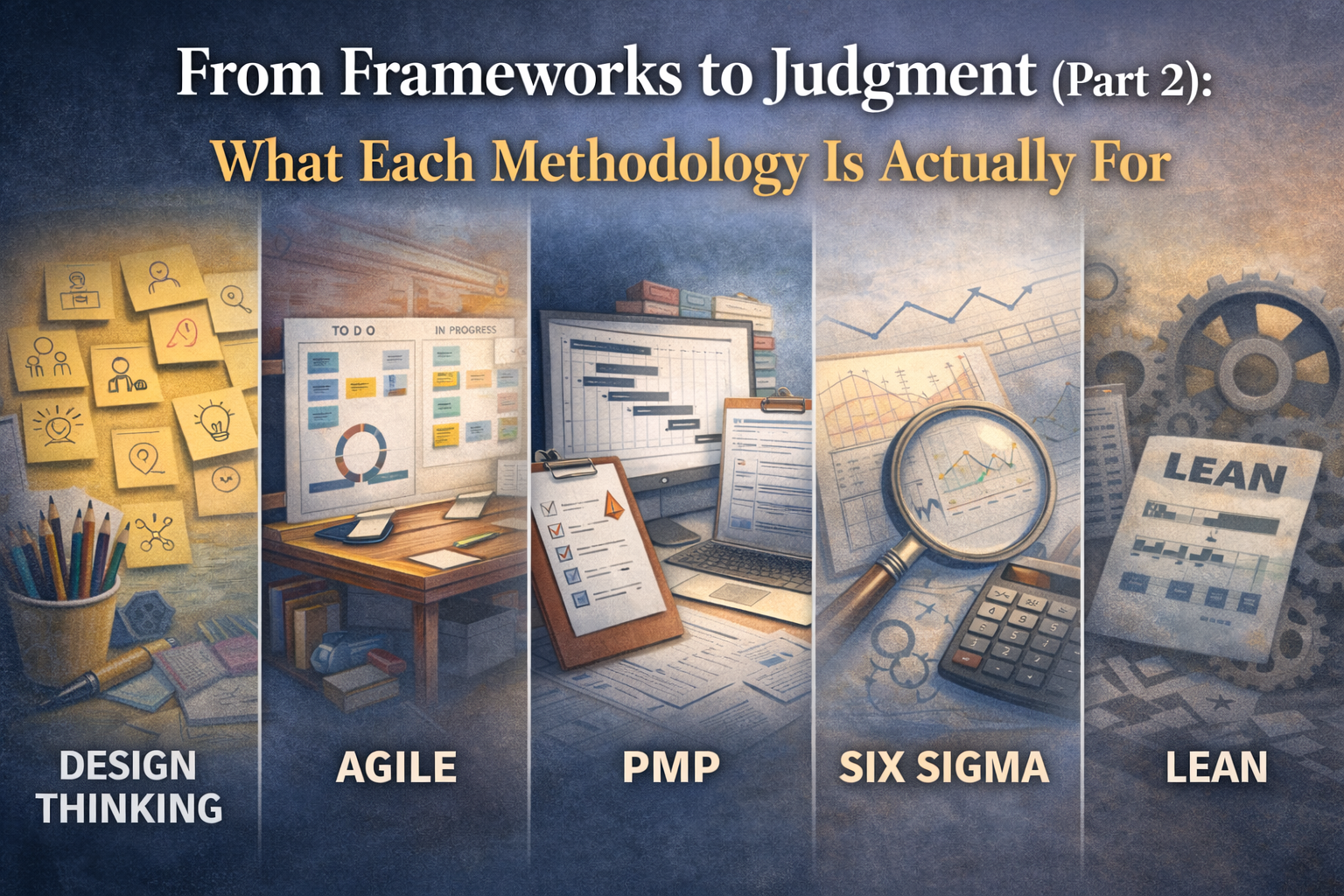
From Frameworks to Judgment (Part 2): What Each Methodology Is Actually For
If Part 1 was the warning, this is the map.
Editor’s Note
This article is part of a four-part series, From Frameworks to Judgment, on how leaders choose and apply methodologies based on the state of the work. If you arrived here directly, you can view the full series at angeloarezzi.com/from-frameworks-to-judgment.Jeff appears throughout the series as a composite senior leader, used to make explicit the decision logic experienced leaders already use intuitively but rarely articulate.
Each methodology below is described in executive terms. Purpose, best fit conditions, and the most common misuse. This is the level leaders need for guidance and oversight, not an implementation manual.
Design Thinking
Optimizes for problem discovery, ideation, reframing, shared understanding.
Best used when the problem is unclear, assumptions need to be challenged, or human impact is central.
Leader misuse treating it as a workshop series with no handoff to delivery and governance, or treating empathy artifacts as proof of progress.
Callout
Design Thinking is a thinking methodology. It is not a delivery model.
Agile Delivery
Optimizes for adaptability, learning through delivery, fast feedback loops.
Best used when requirements evolve and learning must occur during execution.
Leader misuse delegating direction to teams and calling it empowerment, measuring output velocity and calling it outcomes, running sprints with no strategic guardrails.
Callout
Agile is not a strategy. It is a delivery posture, it still requires intent, priorities, and constraints.
PMP, Traditional Project Management
Optimizes for governance, coordination, risk management, delivery discipline.
Best used when scope is largely known, risk is high, multiple functions must coordinate, visibility matters.
Leader misuse freezing learning too early, equating schedule compliance with value, turning governance into bureaucracy instead of decision clarity.
Callout
Project management controls execution. It does not validate intent.
Six Sigma, Lean Six Sigma
Optimizes for defect reduction, repeatability, stability, measurable improvement.
Best used when work is repeatable, measurable, and already understood.
Leader misuse applying it too early, over optimizing immature work, driving local optimization at the expense of end to end outcomes.
Callout
Six Sigma assumes the problem is known. It is an improvement engine, not a discovery engine.
Lean Thinking, Value Stream Management
Optimizes for end to end flow, waste reduction, system performance, cross functional alignment.
Best used when work crosses functions and delays are systemic, handoffs and queues are driving cost and experience.
Leader misuse treating Lean as a toolkit rather than a management philosophy, avoiding incentive and boundary changes, doing mapping without acting on what the map reveals.
The Point
Each methodology solves a different leadership problem. None of them are complete on their own. Leaders should stop asking which framework is best, and start asking what mode the work requires right now.
Callout
Explore, experiment, govern, optimize. Choose the mode before you choose the method.
Further Reading, Practitioners Worth Studying, Not Following Blindly
This is not a certification reading list. These are voices that go deeper than surface level frameworks and help leaders build judgment.
- Design Thinking, Tim Brown, IDEO U, https://www.ideou.com/pages/design-thinking
- Systems Thinking, The Systems Thinker, Peter Senge related materials, https://thesystemsthinker.com
- Agile, Scrum Inc, Jeff Sutherland, https://www.scruminc.com
- Project Governance, Project Management Institute, https://www.pmi.org
- Projects as Strategy, Antonio Nieto Rodriguez, https://www.antionietorodriguez.com
- Lean, Operational Excellence, Lean Enterprise Institute, https://www.lean.org
- Quality, Six Sigma foundations, ASQ, https://asq.org
Where We Go Next
In Part 3, we move from theory to practice through a leader named Jeff. If he sounds familiar, it is because most senior leaders eventually face the same set of pressures.
Next: From Frameworks to Judgment (Part 3): How Leaders Actually Decide
Previous: From Frameworks to Judgment (Part 1): When Methodology Becomes the Work
Series: From Frameworks to Judgment