The Contact Center Is Gone, and That Is a Sign of Progress
Editor’s Note: This article reflects a personal and professional evolution shaped by decades of experience leading and operating service organizations across industries. It is not a critique of the contact center, but a reframing of its role in a connected, enterprise-wide experience model. The disciplines that once lived in a single function now operate across the organization, enabled by experience orchestration, visibility, and human expertise applied where it matters most.
I am an old soul when it comes to the contact center. Aside from a two-week stint in fast food, every chapter of my career has been rooted in this work. I have operated in contact centers around the globe, first with a headset on and later leading teams and organizations. Those roles spanned support, customer success, technology, and sales, across environments of very different scale and complexity. What I learned early is that the contact center is not a role or a title. It is a discipline.
That is why I pause when I hear someone say, “we are not a contact center.” The phrase is often intended to elevate, but it can unintentionally diminish the expertise behind the work. There are contact centers staffed by nurses, financial planners, engineers, and enterprise architects. There are teams solving life-critical problems and others untangling deeply complex platforms. This is not low-skill work, and it never has been. Millions of people around the world apply judgment, empathy, and technical depth every day in these environments, and in very real ways, they keep organizations and economies running.
And yet, after a recent exchange with peers, the realization finally landed while I was flying home from an offsite. They were right, just not for the reason I initially resisted. The contact center has not been diminished. It has been absorbed. In a connected, always-on world, the entire organization now participates in what used to be centralized. Work arrives from every direction. Experience is delivered across journeys, not queues. The principles I grew up with still apply, but the sandbox is no longer a single function. It is the enterprise. That is why I no longer say, “we are a contact center,” and why the evolution of that statement is worth examining.
Conversations about the future of service often become tense the moment the phrase “we are a contact center” surfaces. The reaction is rarely about technology or operating models. It is about perception. That phrase is often heard as a diminishing label, one that frames a team’s expertise as lower or inferior rather than as a reflection of the deep technical, operational, and customer knowledge these teams actually possess.
For decades, the contact center was positioned as a downstream function, optimized for efficiency and cost rather than judgment and influence. Even as organizations grew more complex and service work demanded deeper expertise, the language remained anchored to a transactional past. Over time, the label itself became disconnected from the value the work was delivering.
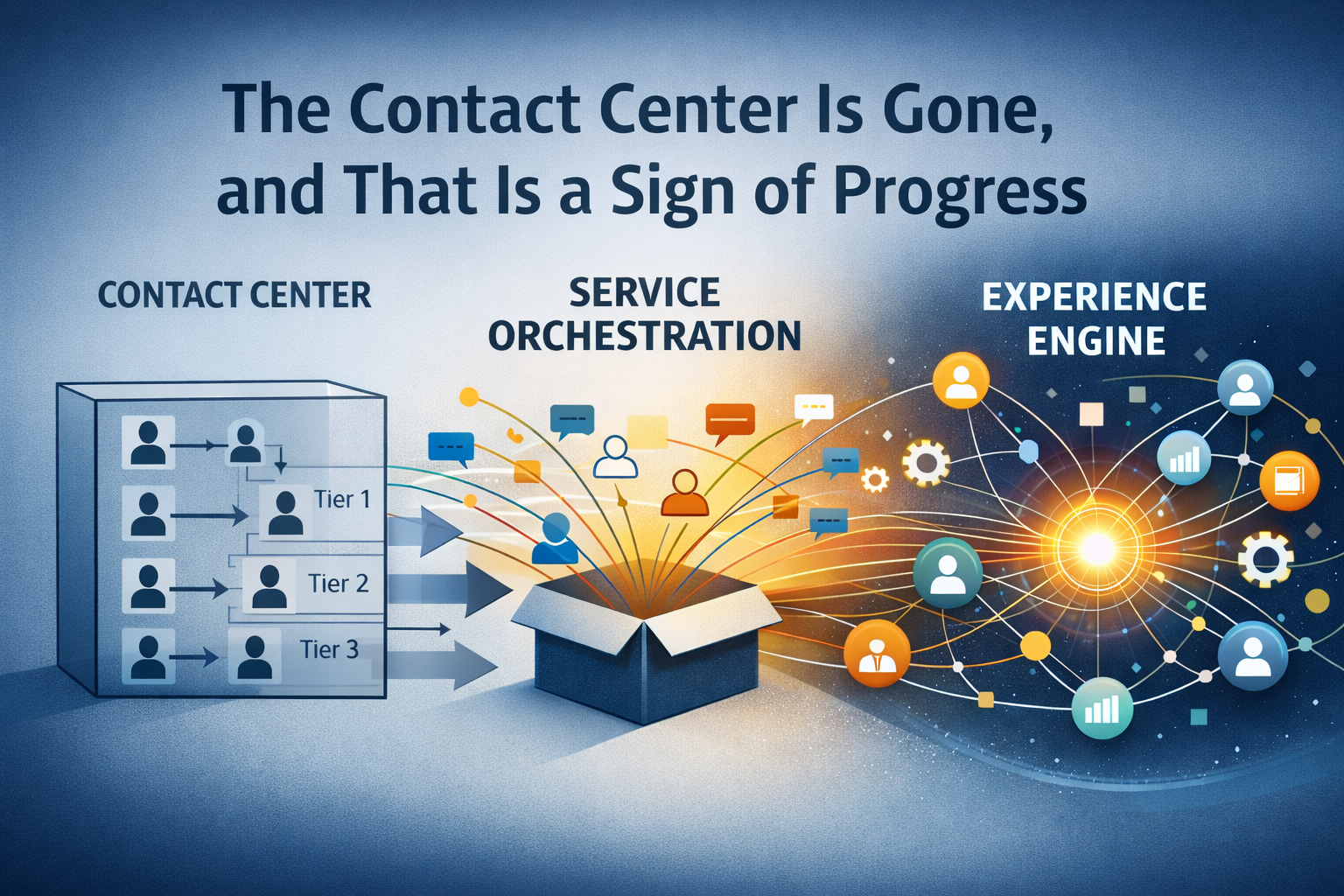
In the 1990s and early 2000s, the contact center emerged as a necessary response to scale. Products were simpler, customer interactions were largely transactional, and centralized queues with tiered escalation allowed organizations to manage demand with consistency and control. Metrics such as handle time, adherence, and cost per contact made sense in that era. The model solved real problems, and it solved them well.
But it was optimized for transactions, not complexity.
As organizations became more interconnected, offerings more configurable, and customers more dependent on outcomes rather than features, the nature of service changed. Customers stopped asking only how something worked and started asking how it fit into their environments, workflows, and broader objectives. Questions increasingly spanned policy, data, integrations, billing, compliance, and operational impact. Expectations for immediacy, continuity, and context rose across every channel.
This is where the traditional contact center model began to strain.
What replaced it is not the absence of service, but an experience-orchestrated model built around visibility, intelligent automation, and human expertise applied intentionally. Automation absorbs predictable, transactional work so people can focus on the complex problems that require judgment, interpretation, and trust.
Transactional interactions still exist. Customers still need help with access, billing clarity, entitlement questions, and basic guidance. But these interactions are increasingly predictable. They can be anticipated, guided, and resolved through well designed self service and intelligent intake. Customers reach outcomes faster, and teams are no longer anchored to repetitive work that adds little strategic value.
What remains, and what continues to grow, is complexity.
Modern customers bring problems that cut across functions. They want guidance on tradeoffs, integration impacts, performance risks, compliance considerations, and long term implications. These are not entry level issues, and they are not simply escalations. They are cross functional problems that require context, experience, and confidence.
Where Contact Center Discipline Matters More Than Ever
Ironically, as the contact center disappears as a place and a label, its core disciplines become more important than ever.
Monitoring and observing customer interactions now extend far beyond calls or tickets. Coaching is no longer limited to front line roles, but applies to specialists, consultants, and customer facing teams across the organization. Performance management shifts from individual efficiency to journey outcomes and customer impact. Capacity planning and forecasting inform not just staffing decisions, but launches, migrations, seasonal demand, and risk events. Real time adherence evolves into real time operational awareness across workflows. Continuous improvement and voice of the customer programs become enterprise feedback loops rather than department owned initiatives.
These capabilities have spilled into every part of the organization. Product and operations teams rely on service signals to understand friction and failure points. Finance depends on interaction data to explain billing confusion and revenue exposure. Sales and account teams use service insights to identify risk and opportunity. The rigor once confined to the contact center now underpins how the organization operates.
This is why experience orchestration platforms increasingly sit at the center of modern organizational design. They are no longer systems for handling interactions. They function as connective infrastructure, linking channels, data, workflows, and people. They provide the visibility and control required to manage complex journeys across the organization, not just within a single function.
From Escalation Paths to Intentional Experience Orchestration
In an experience-orchestrated model, complexity is routed intentionally. Intelligent intake captures context, recent changes, patterns, and known risks before a human ever engages. Escalation is no longer sequential. A customer facing a high impact issue may work directly with someone who understands the broader system and downstream implications. Resolution improves not because more people are involved, but because the right expertise is engaged at the right moment.
As automation absorbs transactional volume, service, billing, and support teams evolve into consultative roles. They identify patterns, surface systemic risk, and influence decisions upstream. A recurring issue triggers a process change. A pattern of confusion leads to policy simplification. Service teams become extensions of the organization rather than downstream recipients of its decisions.
This evolution creates a durable competitive advantage. In environments where offerings converge and pricing pressure is constant, experience becomes the differentiator. Customers remember clarity, confidence, and how an organization shows up when complexity arises. Service organizations increasingly represent the clearest signal of operational maturity and institutional competence.
A Necessary Counterpoint
This transformation is not automatic, and it is not without risk. Poorly designed automation can amplify confusion. Over optimization for deflection without visibility erodes trust. Treating experience orchestration as a tooling exercise rather than an operating model recreates old problems at higher speed. Success requires governance, clear ownership of journeys, and a commitment to human accountability when complexity demands it.
What This Means for Leaders
This is not a story about replacing people with machines. It is a story about repositioning expertise. Transactional work scales through automation. Complex problem solving scales through systems that remove noise and deliver context. Leaders who continue to manage service through the lens of a traditional contact center risk undervaluing one of the most strategically important capabilities in the organization.
The contact center is gone as a place, a label, and a limiting frame. What remains is an experience engine powered by experience orchestration platforms that elevate expertise, preserve context, and enable organizations to meet complexity with confidence.
That is not the end of the contact center. It is the evolution that finally reflects the expertise that has always been there.