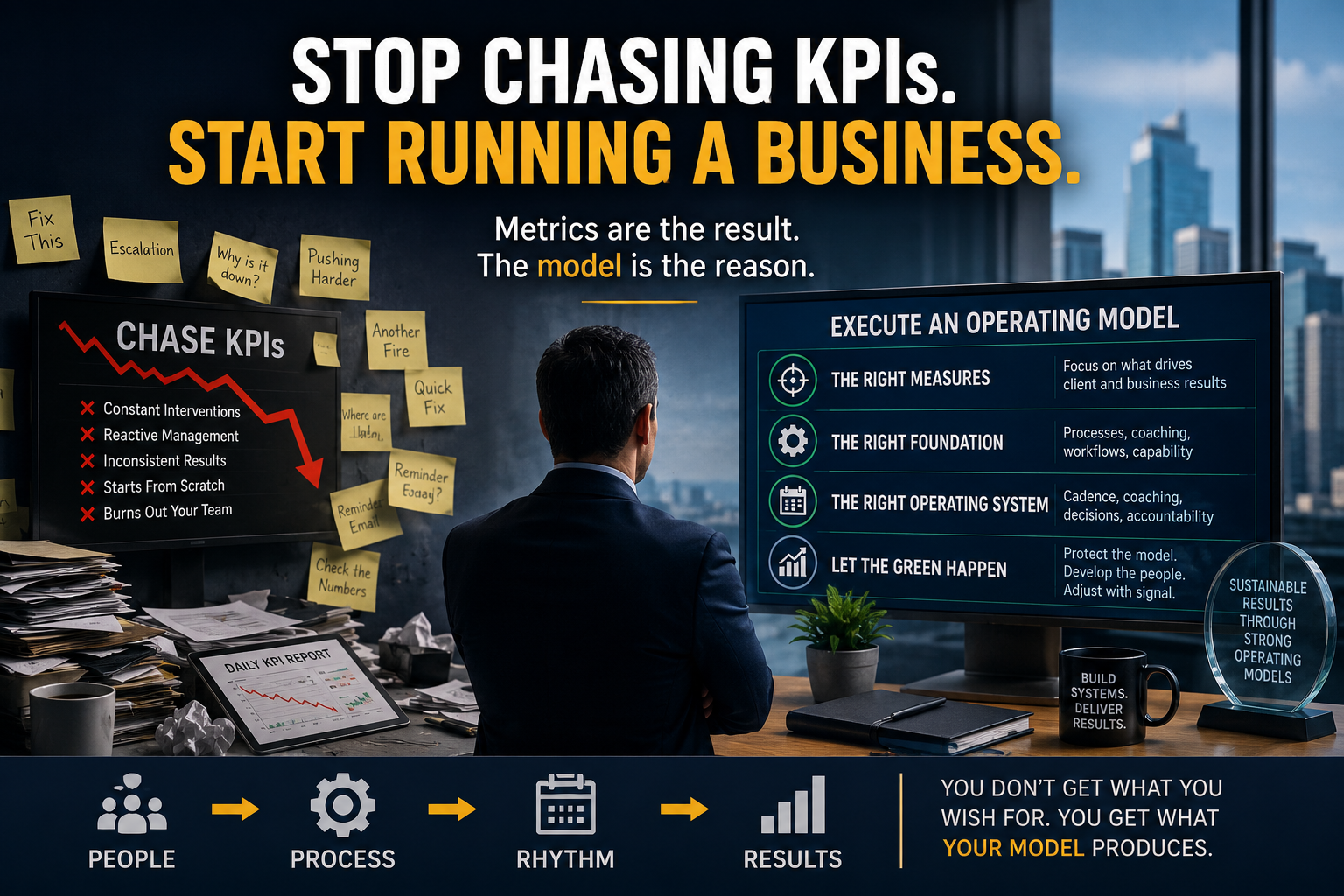
Most leaders are chasing KPIs. That is not the same as running a business.
The question is not whether your numbers are green. It is whether your model is the reason.
Early in my career as a team manager, I learned something that looked like a lesson in performance and turned out to be a lesson in systems.
I found the fastest path to green. Hit the number. Reset. Repeat.
It worked. Until it did not.
Every cycle demanded more intervention. Every period started from scratch. Nothing compounded. The team was busy. The numbers moved. But the moment I looked away, the numbers moved back.
What I was doing was managing metrics. What I needed to build was what produced them.
The Difference Between a Metric and a Model
A KPI is a measurement. It tells you where you are. It does not tell you how you got there, why you will stay there, or how to get somewhere better.
An operating model is the system that produces consistent results. It is the foundation beneath the metric. When the model is right, the metric follows. When the model is missing, the metric becomes the work itself.
Here is how to tell the difference in your own organization. Ask your team leads one question:
What did you do this week to move the number?
If the answer is a list of interventions, escalations, and one-off corrections, you are chasing.
If the answer is a description of system execution, coaching disciplines, and operating rhythms, you are building.
The Four-Part Foundation
After years of building and rebuilding operations across client-facing functions, the framework that consistently produces sustainable results is not complicated. It is disciplined.
1. Find the measures that matter.
Not all KPIs are created equal. Most dashboards are full of metrics that describe activity, not outcomes. The measures that matter are the ones with a direct, demonstrable relationship to client experience, team performance, and business results. Identify those. Anchor everything to them. Ignore the rest.
2. Build a foundation that supports those measures.
This is where most leaders stop. They identify the right metrics and skip directly to scorecards. The foundation is the layer in between: process design, coaching structure, workflow logic, team capability. Without it, the metric has no engine. It has only hope.
3. Install the right operating system.
An operating system is the cadence and rhythm of how your team functions. How often you review performance. How coaching is structured. How decisions get made. How escalations are handled. It is not a meeting schedule. It is a management architecture. When it is right, the team runs itself. When it is absent, you are the operating system. That is the most expensive and unsustainable version of leadership.
4. Let the green happen.
When the foundation is built and the operating system is running, your job is not to push harder. It is to protect the model, develop the people executing it, and adjust based on signal, not noise. The results are a byproduct of the system. Treat them that way.
What This Looks Like in Practice
You are chasing KPIs if:
- Your team meetings are dominated by explaining variances
- Performance improves when you are present and slips when you are not
- You are personally involved in most escalations
- Your coaching conversations are reactive, not scheduled
- Each period feels like starting over
You are executing an operating model if:
- Your team can articulate the model without prompting
- Coaching is a system, not a response to a bad week
- Escalations are handled at the right level without your involvement
- Performance is directionally consistent across periods
- You spend more time developing capability than managing output
The Question Worth Asking
At some point in every leader’s development, there is a moment where the old approach stops working. The interventions multiply. The energy required to maintain results goes up. The ceiling gets closer.
That is not a performance problem. That is a systems problem.
Chase KPIs and you will always be chasing. Execute an operating model and the numbers take care of themselves.
If you cannot answer that with confidence, you already know what to build next.
Make it happen.
I use AI for editing, so if you see what looks like AI, it just might be. You can visit my AI Prompt Article or the Professional GPT Playbook to put AI to work for you.