Editor’s Note
This article is part of The Experience Center Operating Model, a series exploring what it actually takes to run a modern support experience center at scale, across people, automation, governance, and culture.
You will meet Jeff throughout this series. Jeff is a fictional character, but his situations are not. If he feels familiar, it is because most leaders pass through the same moments, face the same pressures, and make the same mistakes, often without realizing what is happening until the system pushes back.
If you arrived at this page by chance or through search, I recommend starting at the main series page to understand why this work exists and how the parts connect.
By the time Jeff sat down for the staffing review, the math finally made sense.
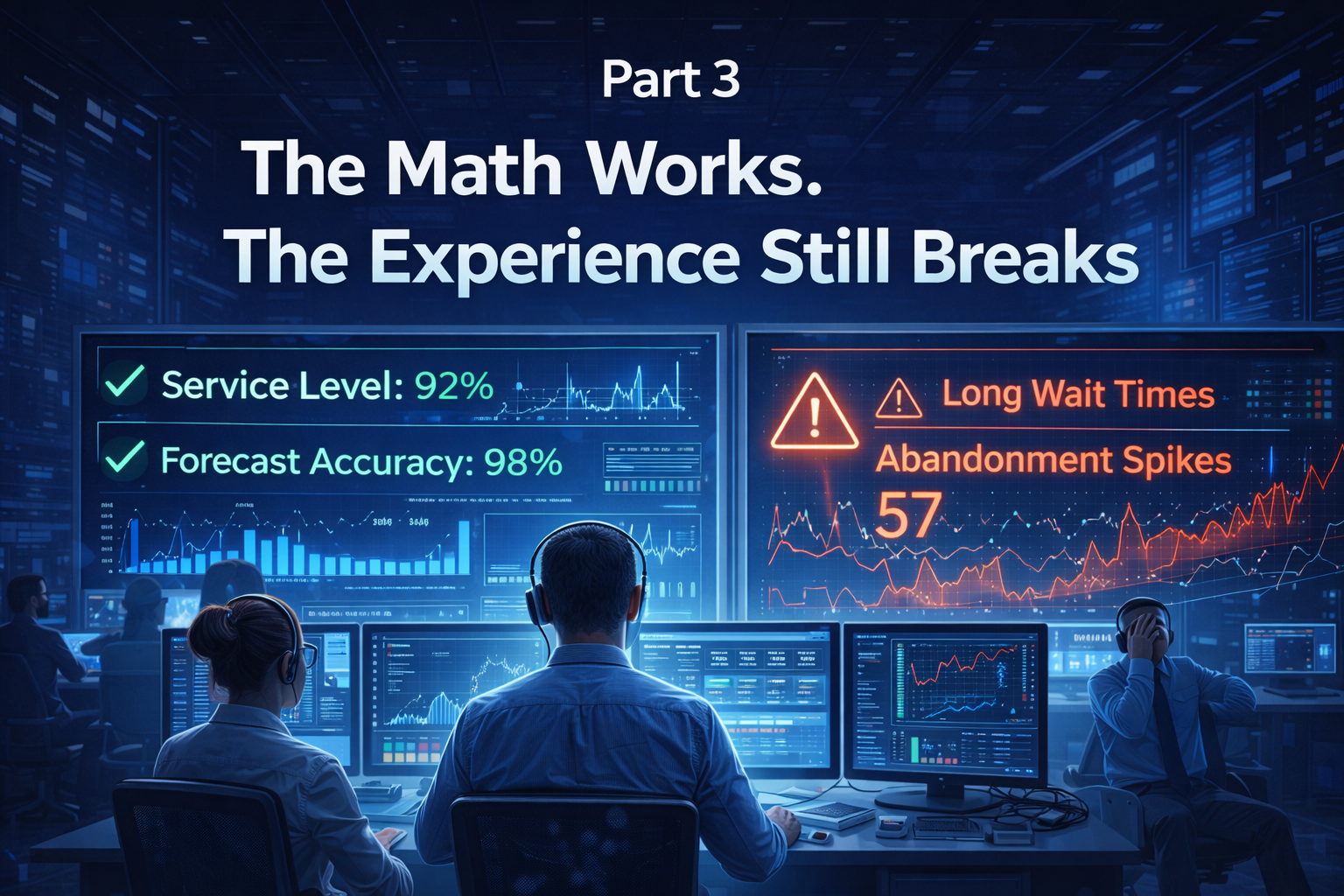
The forecast was solid. The intervals were modeled correctly. Variability had been discussed, debated, and documented. The staffing plan met service targets without blowing the budget. On paper, it was the most defensible plan they had produced in years.
And yet, the experience still broke.
Queues built earlier than expected. Agents logged in on time, but availability evaporated. Managers spent their mornings moving people instead of coaching. By mid afternoon, the experience center was already behind, even though nothing unusual had happened.
That was the third lesson Jeff learned about running a support experience center.
A staffing model can be mathematically correct and still be operationally wrong.
Staffing Assumes Perfect Behavior
Most staffing models are built on an assumption no one states out loud.
That people behave exactly as planned.
Agents will be productive for the full interval. Breaks will start and end on time. Meetings will stay contained. Coaching will happen without pulling capacity. Systems will respond as expected. Customers will follow the happy path.
None of that ever fully happens.
The model did not account for hesitation between contacts. It did not account for agents helping each other. It did not account for the cognitive load of complex work. It did not account for the reality that humans are not machines, even when the system expects them to be.
The math worked because the model assumed perfection.
The experience broke because reality did not.
Leadership Call Out
Assumptions are decisions.
Every assumption in a staffing model represents a choice about risk.
When those assumptions are invisible, the risk is unmanaged.
Utilization Is Not Capacity
The plan looked efficient.
Utilization was high. Occupancy was optimized. Every available minute had been squeezed for productivity. Finance was pleased.
The floor was not.
High utilization left no room to recover. No buffer for surprises. No margin for coaching, learning, or breathing. The moment something slipped, the system had nowhere to go.
Jeff realized they had confused efficiency with resilience.
A support experience center does not fail because people are busy. It fails because there is no space to absorb the unexpected.
Operational Reality Check
Utilization tells you how busy people are.
Capacity tells you how well the system can recover when something goes wrong.
Staffing Is a Design Choice, Not a Constraint
As they reviewed the staffing plan again, Jeff noticed something else.
Every conversation was framed around limitations. Budget ceilings. Headcount caps. Hiring timelines. What could not be done.
Very few conversations were about design.
What behaviors the system was being asked to support. How much time managers were expected to coach. Whether quality expectations matched available capacity. How much variability the experience could tolerate before breaking.
Staffing had become a constraint to work around instead of a design choice to make intentionally.
The plan was optimized for cost.
The experience paid the difference.
What Leaders Often Miss
When staffing is treated as a constraint, experience becomes a casualty.
When staffing is treated as a design decision, tradeoffs become visible and manageable.
The Third Rule of Running a Support Experience Center
Staffing is not about filling seats.
It is about deciding how much stress the system can carry before it fails.
A staffing model that only works when everything goes right is not a plan. It is a hope