Editor’s Note
This article is part of The Experience Center Operating Model, a series exploring what it actually takes to run a modern support experience center at scale, across people, automation, governance, and culture.
You will meet Jeff throughout this series. Jeff is a fictional character, but his situations are not. If he feels familiar, it is because most leaders pass through the same moments, face the same pressures, and make the same mistakes, often without realizing what is happening until the system pushes back.
If you arrived at this page by chance or through search, I recommend starting at the main series page to understand why this work exists and how the parts connect.
Jeff wasn’t worried when he walked into the Monday morning operations review.
The dashboards were green.
Service levels were technically being met.
Headcount was flat. Forecast accuracy looked reasonable.
But his inbox told a different story.
Escalations were climbing. Customer complaints were sharper, more specific, less emotional, more damning. Managers were asking for exceptions, emergency overtime, temporary coverage shifts, last minute schedule changes. Everyone felt pressure, but no one could clearly explain why.
That was the moment Jeff learned his first real lesson about running a support experience center.
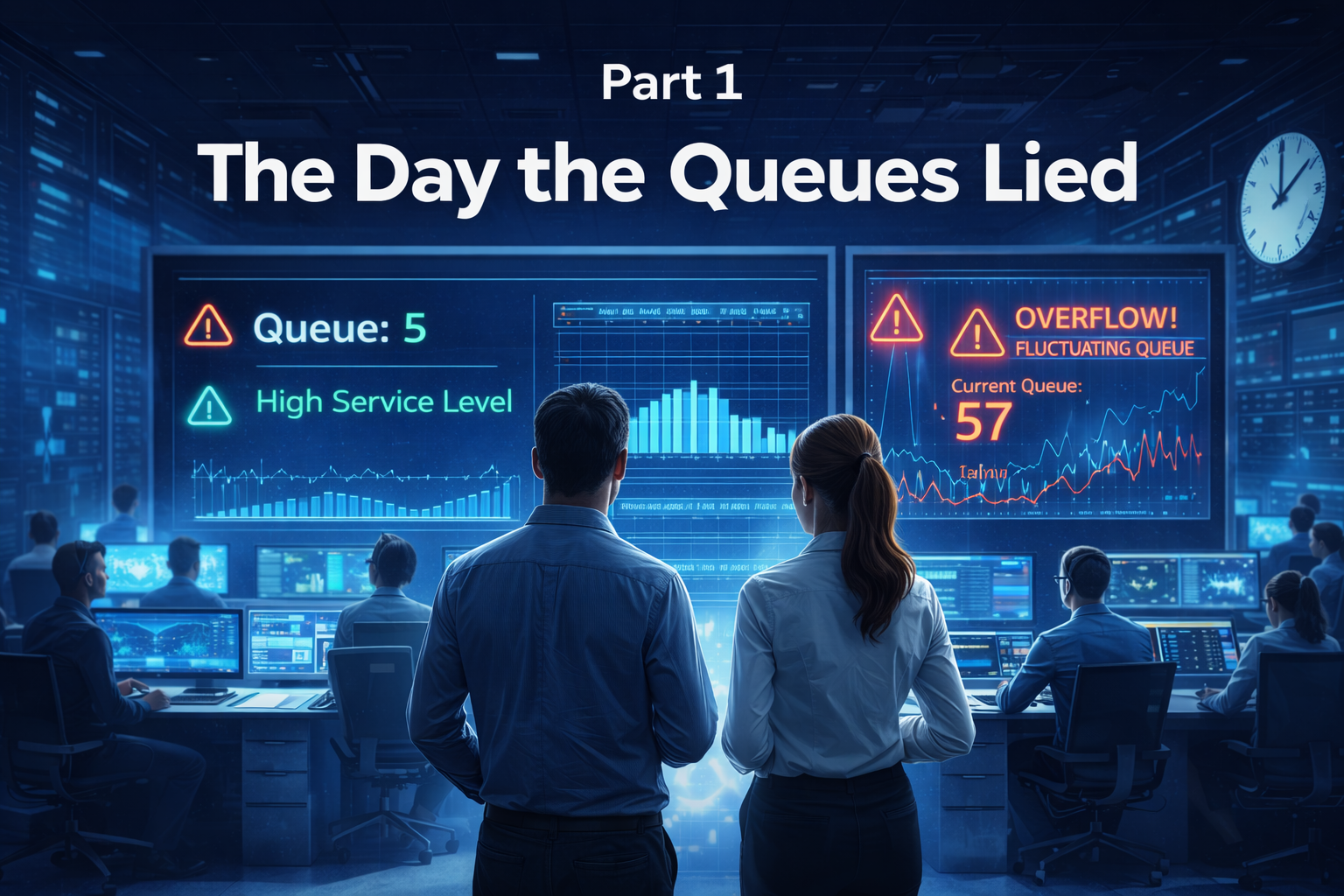
Queues don’t tell the truth. They tell a version of it.
When Volume Becomes a Lie
Most customer experience centers believe they understand demand because they can count it.
Calls per day.
Chats per hour.
Tickets per week.
The numbers are clean, familiar, and reassuring.
But demand is not volume.
Demand is behavior.
It is how customers arrive, when they arrive, how long they are willing to wait, how often they retry, and what they do when the system does not respond the way they expect. Two days with identical volumes can produce completely different outcomes if arrival patterns shift, concurrency changes, or patience drops.
Jeff’s team had not missed demand.
They had flattened it.
They forecasted averages. They staffed to totals. And in doing so, they ignored variability, the single most dangerous force in a live experience environment.
Leadership Call Out
The average is a trap.
Averages hide peaks, mask compounding effects, and create false confidence.
If your plan only works on an average day, it does not work.
Workforce Management Is Not a Scheduling Function
This is where many organizations get workforce management wrong.
They treat it as an administrative layer. Forecasts. Schedules. Adherence reports. Important, but tactical. Something to fine tune after strategy is already set.
In reality, workforce management is strategy, whether leadership wants to admit it or not.
Nearly every operational outcome in a customer experience center traces back to WFM decisions.
- How long customers wait
- How quickly agents burn out
- Whether managers have time to coach
- How quality fluctuates week to week
- Whether automation and AI initiatives appear to succeed or fail
Jeff started to see a pattern. Every downstream initiative was built on assumptions that no one had challenged. The organization kept fixing symptoms while ignoring the system that created them.
Operational Reality Check
When workforce management is wrong, everything else compensates.
Managers improvise.
Agents absorb the pressure.
Customers feel the friction.
The system does not collapse all at once. It erodes quietly.
The Moment Everything Clicked
The shift came later that week.
Maria, the WFM lead, did not bring a new dashboard. Instead, she showed Jeff something he had never seen presented together.
- Intraday arrival patterns by interval
- Abandonment curves aligned to staffing gaps
- Repeat contact behavior following short service dips
The green days were hiding red moments.
Ten minute understaffing windows that snowballed into hour long backlogs. Small spikes that triggered retries, inflating demand later in the day. Service levels technically recovered, but the system never truly caught up.
This was not an execution problem.
It was not an agent performance issue.
It was not a leadership failure.
It was a design problem.
What Leaders Often Miss
Most experience failures are not single events.
They are the compound effect of small, tolerated mismatches between demand and capacity.
The First Rule of Running a Support Experience Center
Before you automate.
Before you hire.
Before you redesign onboarding, coaching, or quality.
Do we actually understand our demand, or are we managing averages and hoping the system holds?
Workforce management is not about predicting the future perfectly. It is about understanding how fragile your experience system is to variability, and designing for that reality.
Jeff did not fix anything that week.
What he did do was stop trusting the queues at face value.
The next week, he asked Maria a simple question.
“Walk me through how we actually forecast this place.”
That conversation changed everything.