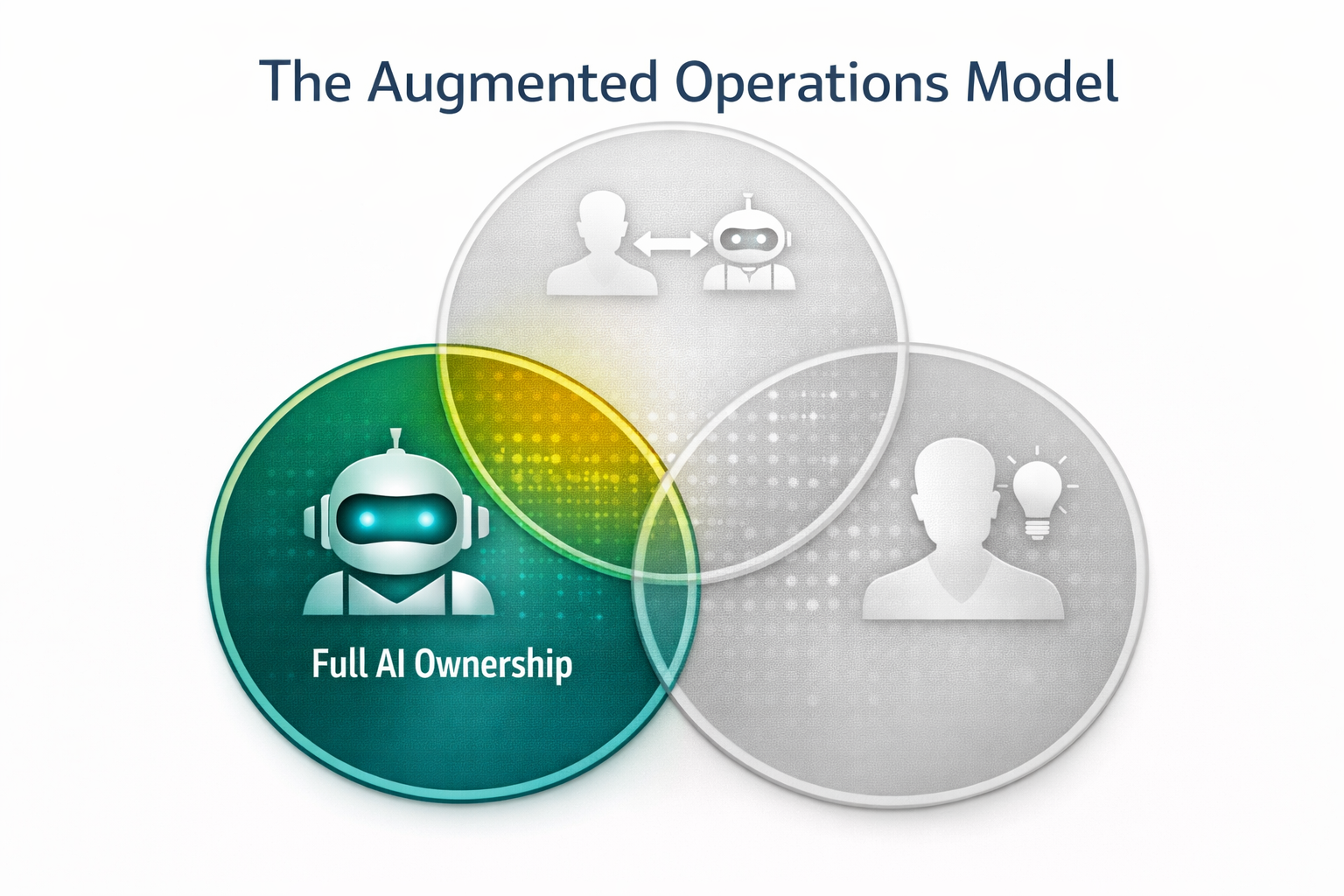
This article is part of the Augmented Operations Model series on designing work for AI and humans.
One of my first trips as a Team Manager was to headquarters for training.
I decided to embrace the “new” technology at the time, GPS. No printed directions. No backup plan. Just trust the system.
It failed in all the ways that matter.
The technology lagged, missed turns, and recalculated constantly. A four hour drive turned into six because the workflow simply was not ready.
I adopted too early without understanding where the system could and could not perform.
That lesson still shows up today.
The First Mode of the Augmented Operations Model
Most organizations are not overusing AI. They are underusing it in the places it should fully own.
This is the first mode of the Augmented Operations Model.
When work is high volume, repeatable, and follows a clear decision path, AI should not assist. It should lead.
Leaders keep humans in the loop “just in case,” adding cost, slowing execution, and introducing variability into processes that should be consistent by design.
This is not risk management. It is workflow avoidance.
The Discipline of Workload Documentation
If the decision can be standardized and the outcome is predictable, AI should own it.
It starts with clearly documenting the workload:
- What triggers the work
- The steps involved
- The decisions made
- The expected outcome
Without this, organizations do not automate workflows. They automate assumptions.
The Real Risk
The real risk is leaving humans in work that should no longer require them.
The question is not “Can AI do this?” The question is: Why are humans still doing it?
Continue the series: AI with Human in the Loop | Human-Led Work | Full Model