Lately, I have been asked a variation of the same question:
“How do you set teams up for success with AI?”
My answer tends to surprise people.
Because it is not rooted in the latest model, newest platform, or biggest technology investment.
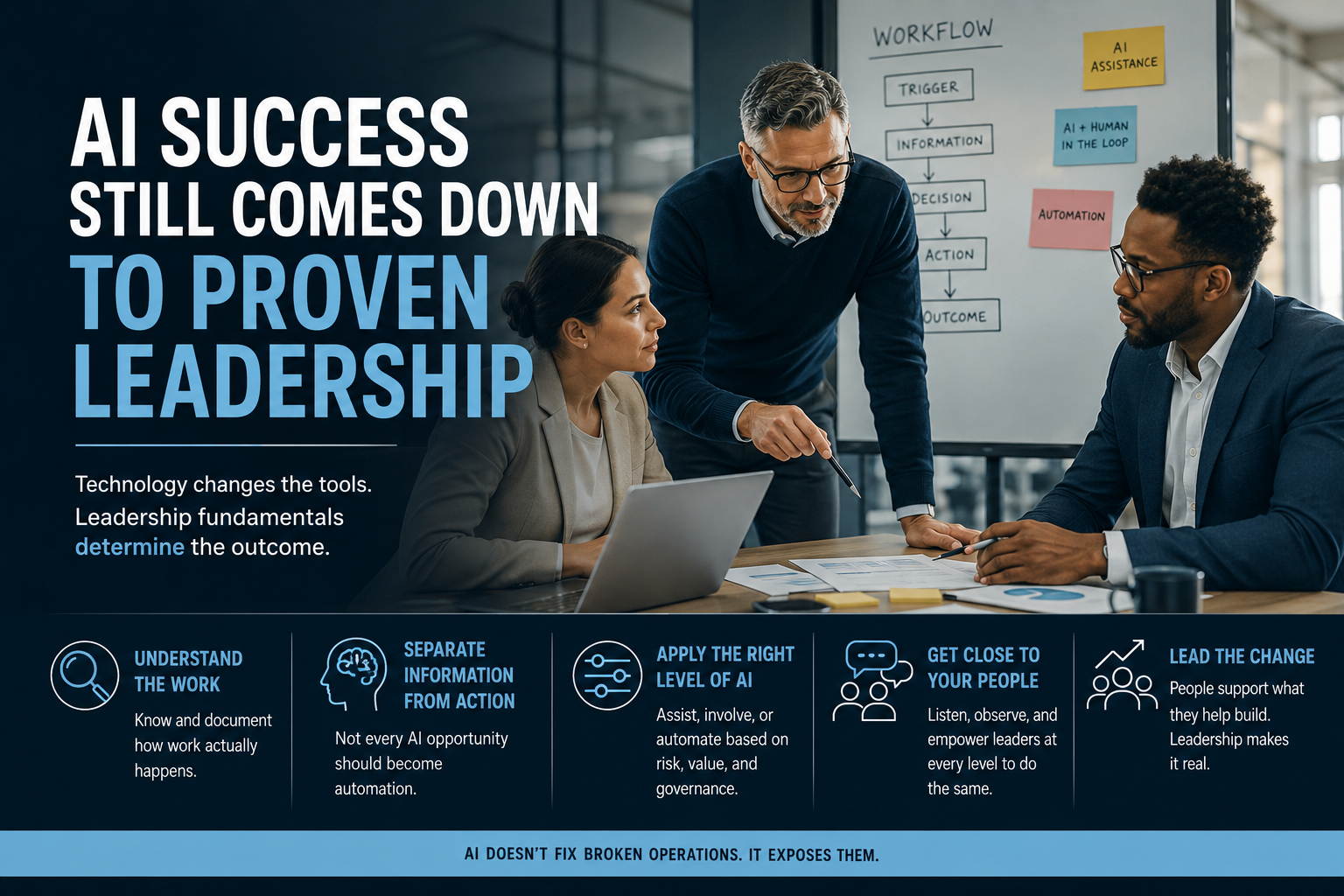
It is rooted in proven leadership fundamentals.
The same fundamentals that have driven successful transformations for decades.
Too many organizations approach AI backward. They start with tools, experimentation, and broad mandates to “go use AI,” only to discover inconsistent outcomes, governance concerns, poor adoption, and frustrated employees.
The reality is simpler than many leaders want to admit:
If your workflows are unclear, AI will amplify the confusion.
If your operating model lacks discipline, AI will scale inconsistency faster than humans ever could.
The organizations succeeding with AI are not necessarily the ones with the largest budgets or newest technology.
They are the ones practicing leadership fundamentals exceptionally well.
Start by Understanding How Work Actually Happens
One of the oldest leadership lessons still applies:
You cannot improve what you do not understand.
Before implementing AI, leaders must understand how work actually happens.
Not how the PowerPoint says it happens.
Not how executives assume it happens.
How it actually happens.
This means documenting workflows in a way that is practical and observable:
- What triggers the work?
- What information is required?
- What decisions are made?
- What systems are touched?
- What outcomes are expected?
A truth many leaders discover quickly:
The documented workflow and the actual workflow are often not the same thing.
That gap matters.
Because if you automate the wrong process, you simply scale inefficiency faster.
AI performs best inside clearly understood workflows. Without that structure, teams improvise, create fragmented processes, and produce inconsistent outcomes.
Operational discipline still matters.
Learn the Difference Between Information and Action
One of the simplest exercises leaders can do when evaluating AI opportunities is separating work into two categories:
Information work and action work.
Information work includes activities like:
- Summarizing
- Researching
- Translating
- Drafting
- Synthesizing data
- Recommending next best actions
Action work includes:
- Updating systems
- Triggering workflows
- Sending communications
- Making approvals
- Executing operational tasks
Why is this important?
Because not every AI opportunity should become automation.
Sometimes the highest value comes from better augmentation, helping people think faster, make stronger decisions, or spend less time searching for information.
Leaders often rush to automate when they should first focus on improving decision quality.
In many cases, AI as augmentation first and automation second leads to stronger adoption and better outcomes.
Not Every Problem Needs Full Automation
Another leadership mistake I see repeatedly:
Treating every AI opportunity like an automation opportunity.
Not all work carries the same level of risk, repeatability, or complexity.
Some work benefits from AI assistance.
Some work requires human validation.
Some work can responsibly run on its own.
The discipline is knowing the difference.
There are generally three levels leaders should think about:
AI Assistance
Human led, AI supported.
Examples include:
- Drafting communications
- Summarizing meetings
- Knowledge retrieval
- Coaching recommendations
- Content generation
Here, AI improves speed and quality while humans remain fully accountable.
AI with Human Validation
AI recommends, humans decide.
Examples include:
- Routing recommendations
- Risk scoring
- Suggested customer responses
- Escalation detection
- Forecasting recommendations
This is often where organizations find the greatest balance between speed, trust, governance, and outcomes.
True Automation
AI or workflows execute independently.
Examples include:
- Status updates
- Routine operational workflows
- Standardized communications
- Repeatable low complexity tasks
The leadership principle is simple:
Automate what is repeatable, measurable, governed, and low risk.
Just because something can be automated does not mean it should be.
Get Close to Where the Work Happens
This may be the most important leadership lesson of all.
The best insights rarely come from the conference room.
They come from where the work is actually happening.
If leaders want successful AI adoption, they must get closer to the operation.
That means:
- Conducting frontline interviews
- Holding skip level conversations
- Observing workflows in practice
- Listening for friction points
- Empowering leaders at every level to do the same
Your people often understand inefficiencies better than anyone else.
They know where context gets lost.
They know which tasks are repetitive.
They know which decisions take too long.
They know where customers and employees experience friction.
In one transformation effort, what initially looked like an automation opportunity turned out to be something entirely different.
Leadership assumed the biggest bottleneck was execution speed.
After spending time with frontline teams and observing the work directly, it became clear the real issue was fragmented information and inconsistent access to knowledge.
The answer was not full automation.
It was AI augmentation.
The result was faster outcomes, better consistency, and stronger adoption because the solution addressed the actual problem, not the assumed one.
People support what they help build.
And transformation moves faster when employees feel empowered to shape the future of work instead of feeling like change is happening to them.
Leadership Fundamentals Still Win
After decades of transformation work, one truth continues to emerge:
New technology changes the tools.
Leadership fundamentals determine whether transformation succeeds.
Clear workflows.
Defined ownership.
Operational discipline.
Human centered change management.
Getting close to the work.
AI does not replace these things.
It magnifies them.
The future of AI will not be won by organizations with the most tools.
It will be won by organizations that understand their work, empower their people, and apply AI with discipline.
Because AI does not fix broken operations.
It exposes them.