Editor’s Note
This article is part of The Experience Center Operating Model, a series exploring what it actually takes to run a modern support experience center at scale, across people, automation, governance, and culture.
You will meet Jeff throughout this series. Jeff is a fictional character, but his situations are not. If he feels familiar, it is because most leaders pass through the same moments, face the same pressures, and make the same mistakes, often without realizing what is happening until the system pushes back.
If you arrived at this page by chance or through search, I recommend starting at the main series page to understand why this work exists and how the parts connect.
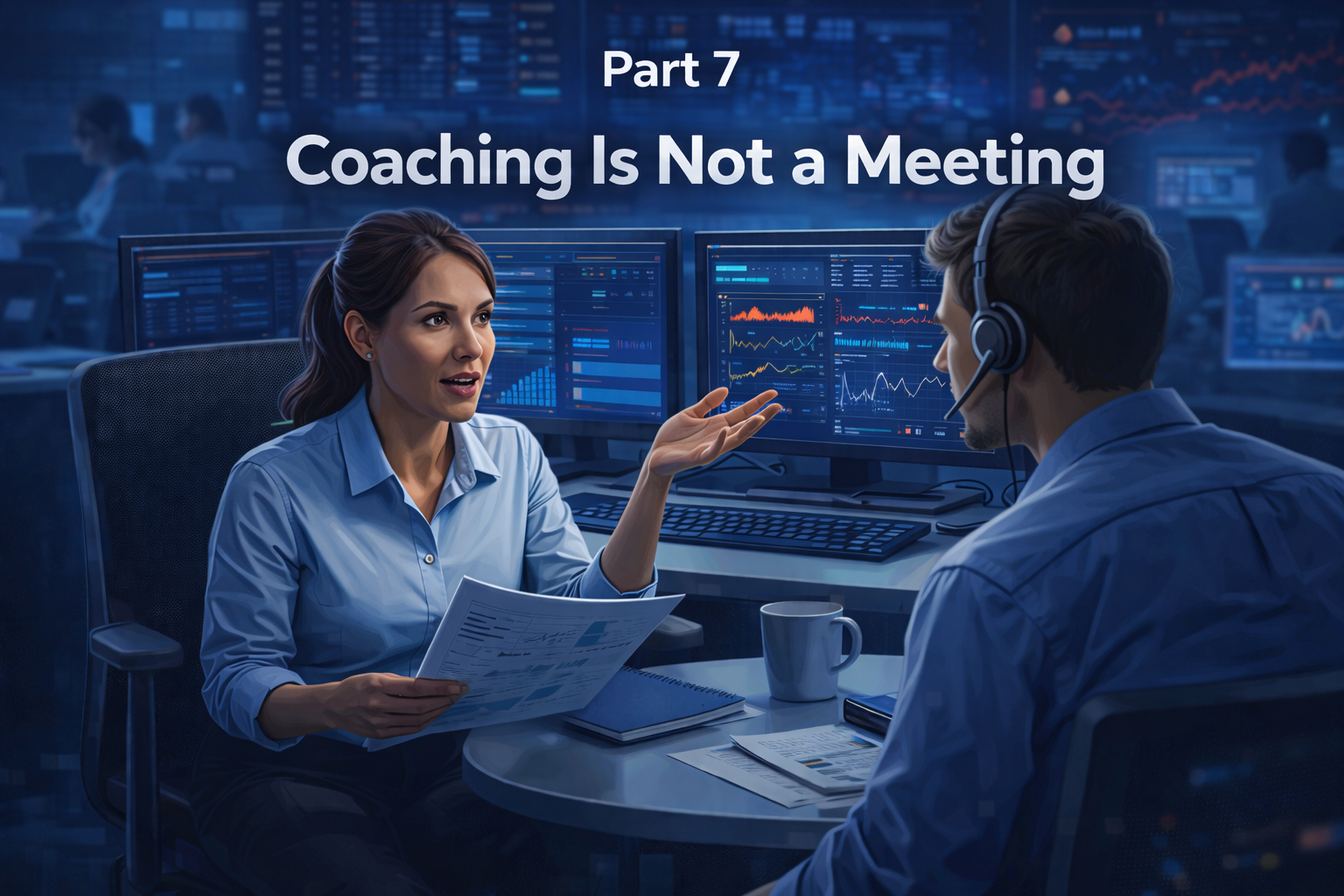
Jeff believed in coaching.
He talked about it often. He funded programs. He approved tools. He expected managers to coach regularly and meaningfully.
And on paper, they did.
Calendars were full. One on ones happened. Feedback was given. Notes were captured. Everyone could point to activity.
Behavior did not change.
That was the seventh lesson Jeff learned about running a support experience center.
Coaching is not a meeting. It is a system.
Activity Is Not Impact
The coaching metrics looked healthy.
Sessions completed. Forms filled out. Time spent. Participation rates. Everything leadership usually asks for.
What they did not see was improvement.
The same behaviors showed up week after week. The same errors reappeared. The same agents struggled in the same places. Coaching felt earnest, but ineffective.
Jeff realized something uncomfortable.
They were measuring coaching effort, not coaching outcomes.
Managers were doing what they were asked to do. The system just was not designed to translate conversation into behavior change.
Leadership Call Out
If coaching is measured by activity, it will optimize for completion.
If coaching is measured by behavior change, it will optimize for impact.
Coaching Without Capacity Is Theater
The deeper issue surfaced quickly.
Managers did not have time to coach properly.
They were covering queues. Managing escalations. Supporting nesting. Interpreting dashboards. Attending meetings. Filling gaps created by every upstream decision.
Coaching happened in the margins. Between fires. After hours. When energy was low.
Jeff saw the contradiction clearly.
Leadership declared coaching critical, then staffed and scheduled managers in a way that made it optional.
Operational Reality Check
Coaching capacity is not a soft skill problem.
It is a staffing and prioritization decision.
Generic Coaching Produces Generic Results
Even when time was protected, coaching struggled.
Sessions were broad. Encouraging. Well intentioned. “Be more empathetic.” “Manage time better.” “Ask better questions.”
None of it stuck.
Because behavior change requires specificity.
What exactly should the agent do differently in the next interaction. At what moment. In response to which signal. Using which language or action.
Without that precision, coaching became advice.
Advice rarely survives pressure.
What Leaders Often Miss
Coaching fails when it focuses on traits instead of behaviors.
You cannot coach what you cannot observe and define.
When Coaching Becomes About the Manager, Not the Agent
Jeff noticed the shift once he started listening more closely.
Coaching sessions sounded reasonable on the surface. Calm. Professional. Well intentioned.
But the focus was off.
Managers were no longer coaching for the agent’s growth. They were coaching to relieve their own pressure.
Goals they were accountable for quietly became the center of the conversation. Service levels. Handle time. Backlog. Escalations. The manager’s scoreboard found its way into the session, even when it had little to do with what the agent could realistically control.
“Here’s what I need you to improve.”
“This number is hurting us.”
“We have to get this metric down.”
That was the tell.
The session stopped being about the agent’s development and started being about the manager’s survival.
Agents felt it immediately.
When coaching becomes a place where managers offload their goals, agents stop learning and start protecting themselves. They nod. They agree. They leave knowing what leadership wants, but not how to succeed without cutting corners.
Leadership Call Out
The moment coaching centers on manager goals instead of agent growth,
trust erodes and behavior turns defensive.
Agent Goals and Manager Goals Are Not the Same Thing
Managers own outcomes.
Agents own behaviors.
Confusing the two inside a coaching session is one of the fastest ways to break effectiveness.
Agents cannot directly control service levels.
They cannot own backlog.
They cannot guarantee CSAT.
They can control how they diagnose an issue.
How they explain next steps.
How they verify understanding.
How they decide whether to transfer or resolve.
When managers coach outcomes, agents feel judged.
When managers coach behaviors, agents feel supported.
Jeff made the boundary explicit.
Manager goals stayed with managers.
Agent coaching focused only on behaviors that agents could practice, adjust, and master.
Operational Reality Check
Coaching fails when managers ask agents to carry goals they do not own.
Development only happens when responsibility matches control.
Coaching Must Close the Loop
Maria connected coaching back to the metrics work.
They mapped coaching focus directly to leading indicators.
Reopen rates triggered targeted problem solving coaching. Transfer patterns informed skill based intervention. Long handle times were broken down into observable behaviors, not averages.
Coaching stopped being generic.
It became intentional.
Each session had a clear input, a defined behavior to change, and a way to measure whether it worked.
Not someday.
Next week.
Leadership Call Out
Coaching works when it closes the loop.
Signal, behavior, intervention, measurement.
Anything less is conversation.
The Manager Is Not the System
One final myth had to be addressed.
The belief that great managers would overcome a weak coaching system.
Jeff had strong managers. Dedicated leaders. People who cared deeply about their teams.
They were still failing.
Not because they lacked skill, but because the system expected heroics.
Coaching success depended on individual discipline instead of structural support. When managers burned out or moved on, coaching quality reset.
That was not leadership.
That was fragility.
Operational Reality Check
A coaching model that depends on exceptional managers is not scalable.
A coaching system must make average performance effective.
The Seventh Rule of Running a Support Experience Center
Coaching is not a meeting on a calendar.
It is a repeatable system designed to change behavior under pressure.
If coaching is optional, it will be postponed.
If it is vague, it will be ignored.
If it is not measured, it will not improve.
Jeff stopped asking managers to “coach more.”
He redesigned the system around them.
Protected time. Clear behavioral definitions. Metrics that pointed to action. Feedback loops that showed whether change actually happened.
The result was not louder coaching.
It was quieter improvement.
And once coaching started to work, something else became obvious.
Quality could no longer be treated as sampling.
It had to become intelligence.
When you are ready, we move into Part 8, where manual QA collapses, automation changes the game, and quality finally becomes a tool leaders can trust.