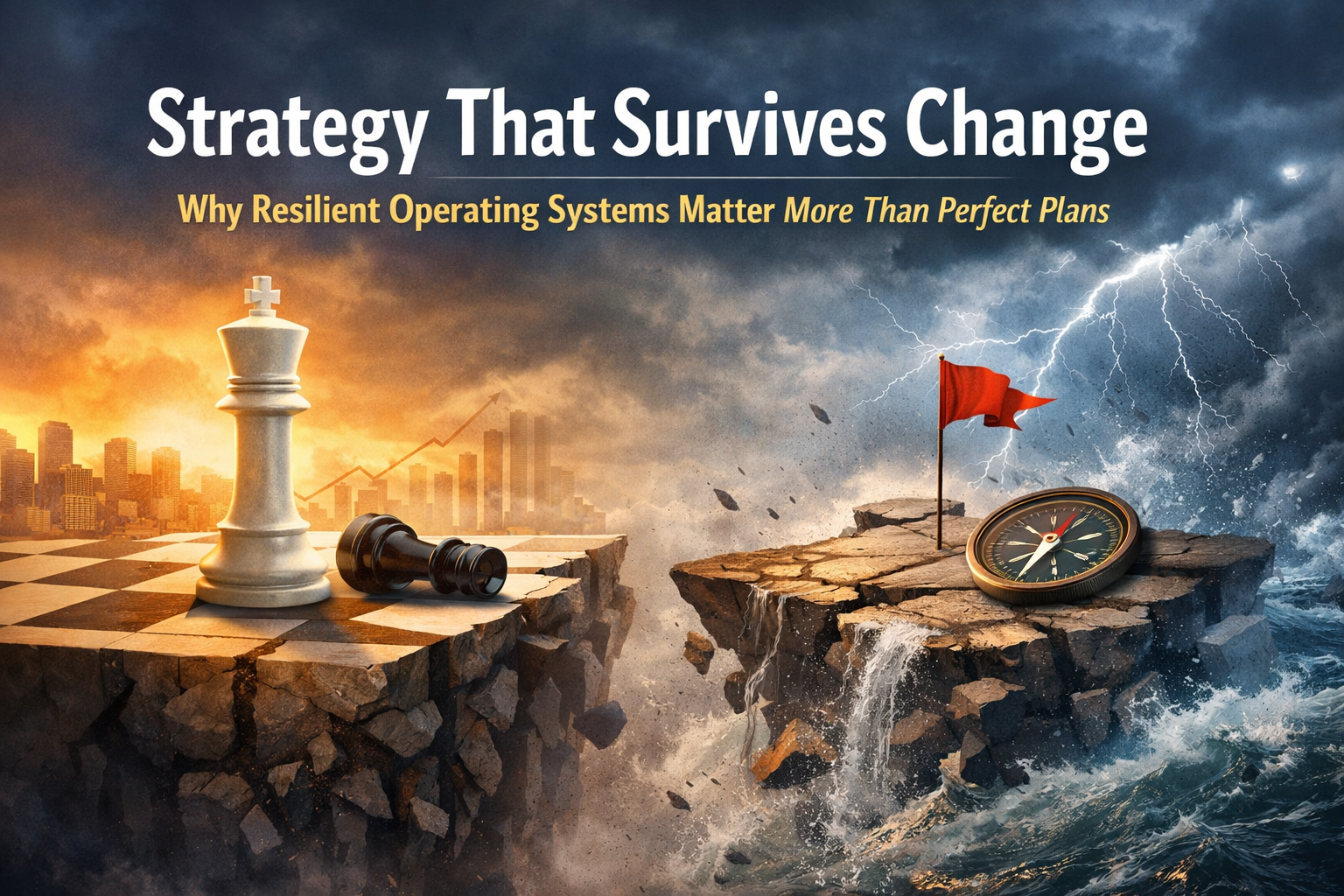
Why Resilient Operating Systems Matter More Than Perfect Plans
Editor’s note
This article is part of The Strategy Operating System series, which explores how leaders design strategy that holds under pressure, scales through people, and survives change. The series follows a composite leader named Jeff to reflect real and recurring leadership challenges. Jeff is fictitious, but the situations are not.
If you found this page on its own, you may want to start at the series overview here:
The Strategy Operating System
By the time Jeff finished rebuilding strategy as an operating system and scaling it through frontline leadership, something important had changed.
Strategy no longer depended on Jeff being in every meeting.
That was progress.
It was also the beginning of the real test.
Because once strategy starts to work, the question is no longer whether it executes.
It is whether it survives leadership change.
The Moment Strategy Is Most at Risk
Most leaders believe strategy fails because execution is hard.
Jeff learned something more uncomfortable.
Strategy fails when power shifts.
Senior leaders leave. New executives arrive. Mandates change. Language changes. Priorities are reframed. What was once considered “non-negotiable” is suddenly described as “open for review.”
This is not malicious. It is structural.
New C-suite leaders are hired to change things. They bring experience, urgency, and a point of view shaped by different environments.
The risk is not that they challenge the strategy.
The risk is that the strategy has no way to withstand the challenge.
When a Senior Leader Leaves
Jeff’s test began quietly.
A long-tenured senior leader, one of the original architects of the strategy, announced their departure. The organization reacted as it always does. Meetings were reshuffled. Interim decisions were made. People waited.
Jeff watched closely.
In the past, this moment would have created drift. Without a visible sponsor, priorities would soften. Exceptions would creep back in. Decisions would stall while leaders waited to see what the next executive wanted.
This time, something different happened.
Decisions continued.
Capacity protections held.
Escalation criteria were enforced.
Metrics were interpreted consistently.
The strategy did not pause.
That alone told Jeff the operating system was working.
When the New C-Suite Leader Arrives
The real test came weeks later.
A new C-suite leader joined with a clear mandate to accelerate change. In their first weeks, they asked the right questions.
Why does it take this long
Why do we do it this way
Why can’t we move faster
These questions were not disruptive. They were expected.
What Jeff paid attention to was how the organization answered them.
Instead of revisiting every decision, leaders referenced existing constraints. Instead of improvising, they explained trade-offs using the current operating model.
The new executive challenged assumptions.
The system absorbed the challenge.
Strategy bent. It did not break.
Why Most Strategies Collapse at This Moment
This is where most strategies quietly die.
New executives bring new narratives. They reinterpret priorities. They reward different behaviors. Without an operating system, strategy becomes personal.
Decisions shift based on proximity to power rather than alignment to outcomes.
Jeff had lived through this cycle before.
What changed this time was that decisions were no longer dependent on individual sponsorship.
They were anchored in structure.
Resilience Is Designed, Not Hoped For
Jeff realized that resilience had nothing to do with rigidity.
It had everything to do with pre-decided flexibility.
Some elements of the strategy were intentionally adaptable.
Others were explicitly protected.
Capacity could flex within defined bounds.
Metrics could rebalance without abandoning outcomes.
Exceptions could be granted within guardrails.
AI capabilities could evolve without changing decision authority.
This clarity made it easier, not harder, for the new executive to engage.
Debate moved faster because the rules were visible.
Strategy Must Outlive Its Authors
At this point, Jeff stopped thinking about strategy as something leaders owned.
He started treating it as something the organization inherited.
That changed how leaders were onboarded.
New executives were not asked to approve the strategy.
They were asked to understand the constraints it imposed.
This did not eliminate change.
It eliminated constant reinvention.
Strategy became institutional, not personal.
Volatility Becomes a System Input
Support organizations operate in constant volatility.
Customer demand shifts. Product complexity increases. AI accelerates expectations. Cost pressure reappears.
Jeff accepted that volatility was not a threat.
Unstructured response to volatility was.
By embedding strategy into capacity management, decision rights, metrics, coaching, and escalation paths, volatility became something the system processed.
Not something it reacted to impulsively.
AI and Leadership Change
AI added another layer of complexity.
New leaders often arrive with strong views on automation, efficiency, and scale. Without guardrails, AI becomes the excuse to rewrite priorities under the banner of innovation.
Jeff avoided this trap.
AI adoption followed existing decision rules.
AI authority evolved within defined boundaries.
AI outcomes were evaluated against strategic commitments.
This allowed innovation without destabilization.
AI accelerated the system.
It did not redefine it.
A Simple Test for Strategic Durability
Jeff used a single question to assess whether strategy was holding.
What decisions remain the same even after leadership changes?
If the answer depended on personalities, strategy was fragile.
If the answer depended on structure, strategy was durable.
That question worked at every level of the organization.
The Cost of Strategy That Endures
Durable strategy is uncomfortable.
It constrains new leaders.
It slows impulsive change.
It forces trade-offs to remain visible.
Jeff absorbed pressure so the system did not reset.
That is the unseen work of senior leadership.
A Board-Level Signal of Maturity
Boards often ask whether the organization can adapt to change.
A better question is whether the organization knows what it will not change when adapting.
Can leadership articulate which constraints hold through executive turnover
Which outcomes remain protected
Which decisions are non-negotiable
If the answer changes with each new C-suite arrival, strategy is fragile.
If it holds, strategy has matured.
Where the Series Goes Next
At this stage, Jeff had achieved something rare.
Strategy executed.
Strategy scaled.
Strategy survived leadership change.
The final challenge remained.
How do you institutionalize this discipline so it endures beyond any individual leader?
That question, and how organizations turn strategy into institutional memory, is the focus of the final post in this series.
The Strategy Operating System Series