There is a moment in almost every career where someone asks a deceptively simple question:
What do you want to be known for?
Most people struggle to answer it.
Not because they lack talent, intelligence, or ambition, but because personal branding is often misunderstood. Many people think it is about social media presence, self promotion, or creating an online persona. In reality, personal branding is something much deeper and far more consequential.
Your personal brand is the consistent perception people have of you when you are not in the room.
It is the emotional and professional residue left behind after interactions, meetings, presentations, decisions, and moments of pressure.
And whether you intentionally shape it or not, your brand is already being formed.
Your Brand Evolves as You Evolve
One of the questions I recently received during a panel discussion was about how someone should “find” their personal brand.
My answer was simple:
It depends on where you are in your journey.
Early in your career, your brand is usually built around curiosity, adaptability, responsiveness, and potential. You are learning how organizations work, how leaders communicate, and how influence is built.
I can clearly see the different phases of my own evolution.
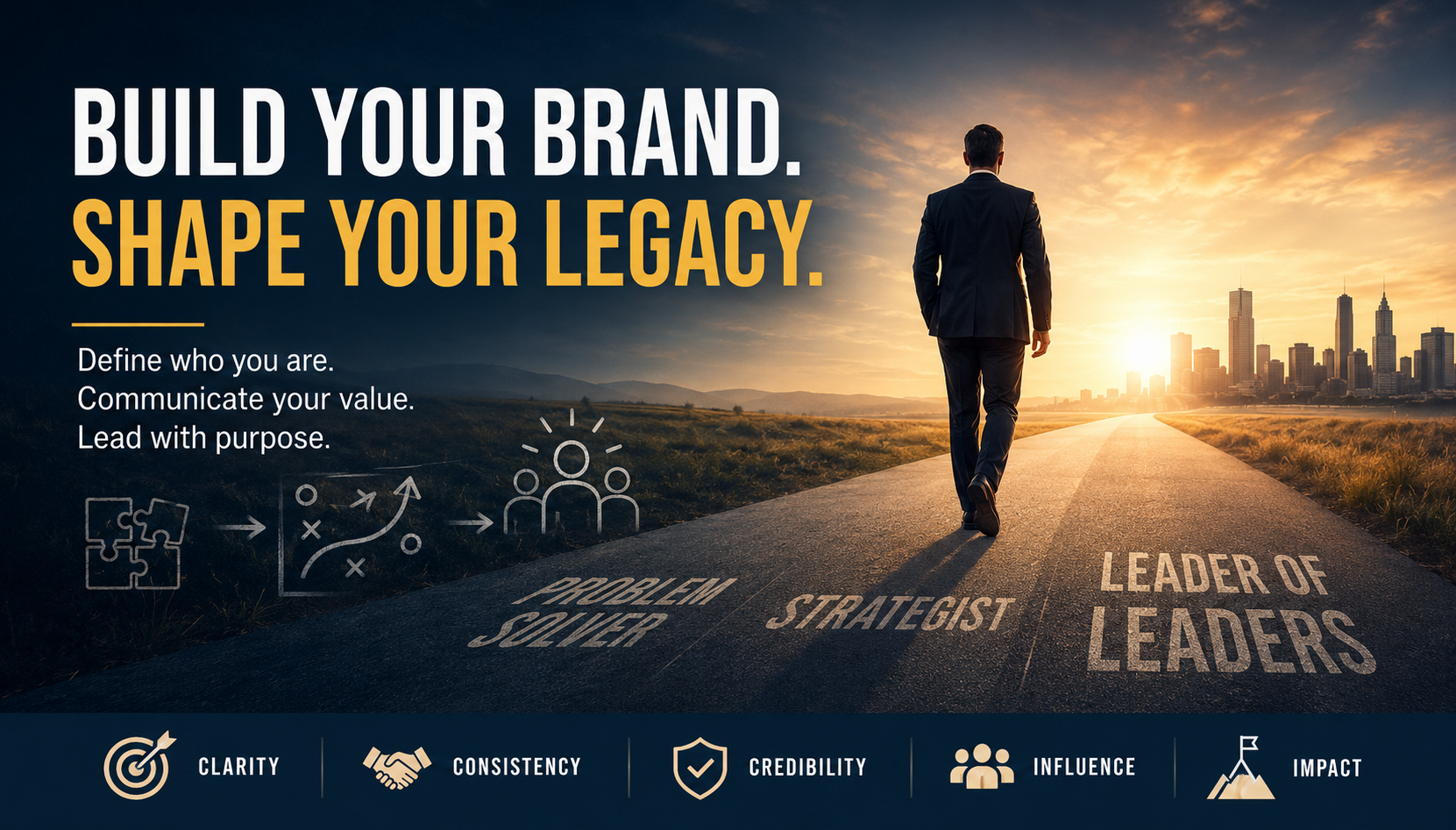
Early in my career, I wanted to be the MacGyver of every situation. I wanted to solve the hardest problems in the room, present answers quickly, and become known as the person who could figure anything out under pressure. My identity was heavily tied to problem solving and technical capability.
Over time, that evolved.
I became more focused on strategy, leadership development, and coaching. The shift was no longer about personally solving every challenge. It became about helping teams think differently, helping leaders navigate complexity, and building operational systems that could scale beyond any one individual contributor.
Today, my focus is even broader.
I think deeply about how to guide leaders, shape operating models, and create environments where teams and business units can consistently perform, adapt, and grow. The value is no longer in being the hero of every moment. The value is in building leaders and systems that continue succeeding long after the immediate problem is solved.
That evolution matters because leadership perception compounds over time.
As your career progresses, your brand becomes more intentional. It shifts from:
- “Can this person do the work?”
- “Can this person lead through complexity?”
- “Can this person influence outcomes?”
- “Can this person be trusted at scale?”
The strongest leaders are rarely accidental in how they present themselves. Their communication style, operating rhythm, executive presence, and values become highly recognizable.
Consider leaders like Steve Jobs, Jeff Bezos, or Satya Nadella. Their public identities evolved dramatically over time. The early versions of these leaders looked very different from the mature executives they eventually became.
Their brands evolved because their leadership maturity evolved.
Herminia Ibarra has written extensively about this concept in leadership transitions, arguing that leadership identity is often developed through experimentation, exposure, and adaptation rather than discovered fully formed. Strong leaders evolve because their environments, responsibilities, and perspectives evolve alongside them.
Your Brand Is Built in Small Moments
Most people believe personal branding is built during keynote speeches, executive meetings, or major public moments.
In reality, it is built in smaller moments repeatedly:
- How you react under pressure
- How you communicate during disagreement
- Whether people experience clarity or confusion after speaking with you
- Whether you elevate or drain the room
- How consistently you follow through
- Whether people trust your judgment
- How you treat people when there is nothing to gain
This is why personal branding is deeply connected to operational consistency.
A leader who speaks about collaboration but creates chaos develops a brand.
A leader who talks about innovation but blocks decisions develops a brand.
A leader who remains calm, structured, and intentional during difficult moments develops a brand.
People remember patterns more than slogans.
Many professionals are optimizing for visibility while unintentionally damaging credibility.
Visibility may accelerate recognition, but credibility is what sustains trust over time.
A personal brand built faster than leadership maturity eventually struggles under pressure, complexity, and scale.
Your personal brand is ultimately your operational model made visible through human interaction.
Executive Presence Is Not About Acting Important
Executive presence is one of the most misunderstood concepts in leadership.
Many people confuse it with charisma, volume, confidence theater, or authority signaling.
True executive presence is much simpler:
It is the ability to create clarity, confidence, and momentum in uncertain environments.
This aligns closely with research from Sylvia Ann Hewlett, whose work on executive presence emphasized that gravitas, communication, and appearance collectively shape how leadership capability is perceived inside organizations.
That presence shows up through:
- Clear communication
- Thoughtful pacing
- Emotional control
- Structured thinking
- Listening well
- Decision discipline
- Consistency between words and actions
Some of the strongest leaders I have worked with were not the loudest people in the room. They were the people who made complexity easier to navigate.
That becomes part of your brand.
The Hidden Risk of Inauthentic Branding
One of the largest mistakes professionals make is trying to copy someone else’s leadership identity.
People imitate communication styles, posting strategies, vocabulary, or public personas without understanding the underlying substance behind them.
Audiences detect this quickly.
Strong personal brands are not manufactured identities. They are amplified authentic strengths.
Many leadership thinkers, including Brené Brown, have emphasized that authenticity matters in leadership. However, authenticity alone is not enough. Sustainable leadership brands require alignment between values, behaviors, communication, and execution.
Your goal is not to become another executive. Your goal is to become the clearest and most disciplined version of yourself.
Authenticity without discipline creates inconsistency.
Discipline without authenticity creates artificiality.
Strong leadership brands require both.
A Practical Framework for Building Your Brand
1. Define Your Leadership Adjectives
Start with a simple exercise.
Ask yourself:
What are the three words I want people to consistently associate with me?
Examples might include strategic, calm, decisive, collaborative, innovative, disciplined, reliable, transformational, thoughtful, or trusted.
Now ask a harder question:
Would the people I work with today actually describe me that way?
The gap between those answers is your development roadmap.
2. Audit Your Current Brand
Write down how you currently show up in these areas:
| Area | Questions |
|---|---|
| Communication | Do people leave conversations with clarity? |
| Meetings | Do I contribute energy or friction? |
| Decision Making | Am I decisive or reactive? |
| Follow Through | Am I known for consistency? |
| Executive Presence | Do I remain composed under pressure? |
| Digital Presence | Does my online presence reflect my leadership values? |
| Relationships | Am I building trust intentionally? |
This exercise often reveals misalignment between intention and perception.
3. Build Brand Through Repetition
Brands are not built through isolated moments. They are built through repeated signals over time.
This includes how you write emails, run meetings, coach others, handle setbacks, present ideas, acknowledge others, and operate when stressed.
Consistency creates trust.
Trust creates influence.
Influence creates leadership scale.
Recommended Authors and Thinkers on Personal Branding
Dorie Clark
Her work focuses heavily on long term professional positioning and becoming a recognized expert in your field.
Recommended books: Stand Out, The Long Game, Reinventing You
Official site: Dorie Clark (https://dorieclark.com)
William Arruda
One of the pioneers in executive personal branding and leadership identity development.
Recommended book: Digital You
Official site: William Arruda (https://www.williamarruda.com)
Herminia Ibarra
Known for her research on leadership transitions and identity evolution.
Recommended book: Act Like a Leader, Think Like a Leader
Official site: Herminia Ibarra (https://herminiaibarra.com)
Amy Cuddy
Her work on presence, communication, and confidence remains highly influential.
Recommended book: Presence
Official site: Amy Cuddy (https://www.amycuddy.com)
Recommended Courses for Personal Branding and Executive Presence
LinkedIn Learning Personal Branding Courses
Excellent practical courses focused on communication, visibility, leadership presence, and professional influence.
https://www.linkedin.com/learning/topics/personal-branding
Coursera Leadership and Personal Branding Courses
Broader academic and professional development programs around leadership communication and influence.
https://www.coursera.org/courses?query=personal%20branding
Harvard Online Leadership Communication Courses
Strong focus on executive communication, influence, and organizational leadership.
https://online.hbs.edu/courses/leadership-principles/
Personal Branding in the AI Era
One of the emerging realities of the AI era is that information is becoming increasingly commoditized.
Technical answers, frameworks, summaries, and even strategic recommendations are becoming easier to generate through AI systems. That shift changes where human differentiation occurs.
As AI commoditizes information, human differentiation increasingly shifts toward judgment, discernment, trust, emotional steadiness, and decision quality.
The leaders who stand out in the next decade will not simply be the most informed. They will be the most trusted.
In the future, leadership brands will increasingly be built around judgment, discernment, emotional steadiness, communication, trust, and orchestration.
AI can accelerate information. It cannot fully replace trusted leadership perception.
As automation expands, the leaders who stand out will not simply be the ones with the most knowledge. They will be the ones most capable of creating clarity, trust, alignment, and momentum in increasingly complex environments.
That is where human leadership becomes more valuable, not less.
Final Thought
Your personal brand is not built in a single post, title, promotion, or speech.
It is built through accumulated moments of consistency.
The way you think.
The way you communicate.
The way you respond under pressure.
The way people experience you repeatedly over time.
That is your brand.
And the leaders who become truly influential are usually the ones who intentionally shape it long before the world fully recognizes it.
Because eventually, every professional develops a reputation.
Titles may open doors, but reputation determines how long trust remains once you enter the room.
In the modern leadership economy, reputation compounds faster than resumes.
The question is not whether you have a personal brand.
The question is whether you are intentionally building one worthy of the responsibility you hope to carry.