One of my leaders asked me recently:
“How can I show more agency?”
So I asked them a different question:
Are you driving progress, or creating disruption that just looks like progress?
It is a strong question.
It is also one of the most misunderstood in leadership.
Most people hear “agency” and translate it into speed.
Move faster.
Push harder.
Drive change at all costs.
I know that instinct well.
Earlier in my career, I believed that was exactly what agency meant.
So I did.
I launched a new process that, on paper, was the right move. It solved real problems. It improved flow. It aligned to the outcomes we were trying to achieve.
And it created chaos.
The rollout disrupted teams. It introduced confusion. It generated rework across functions. The process worked. The organization did not. And the cost of fixing the fallout was greater than the problem I set out to solve.
That experience fundamentally changed how I think about agency, and more importantly, how I coach it.
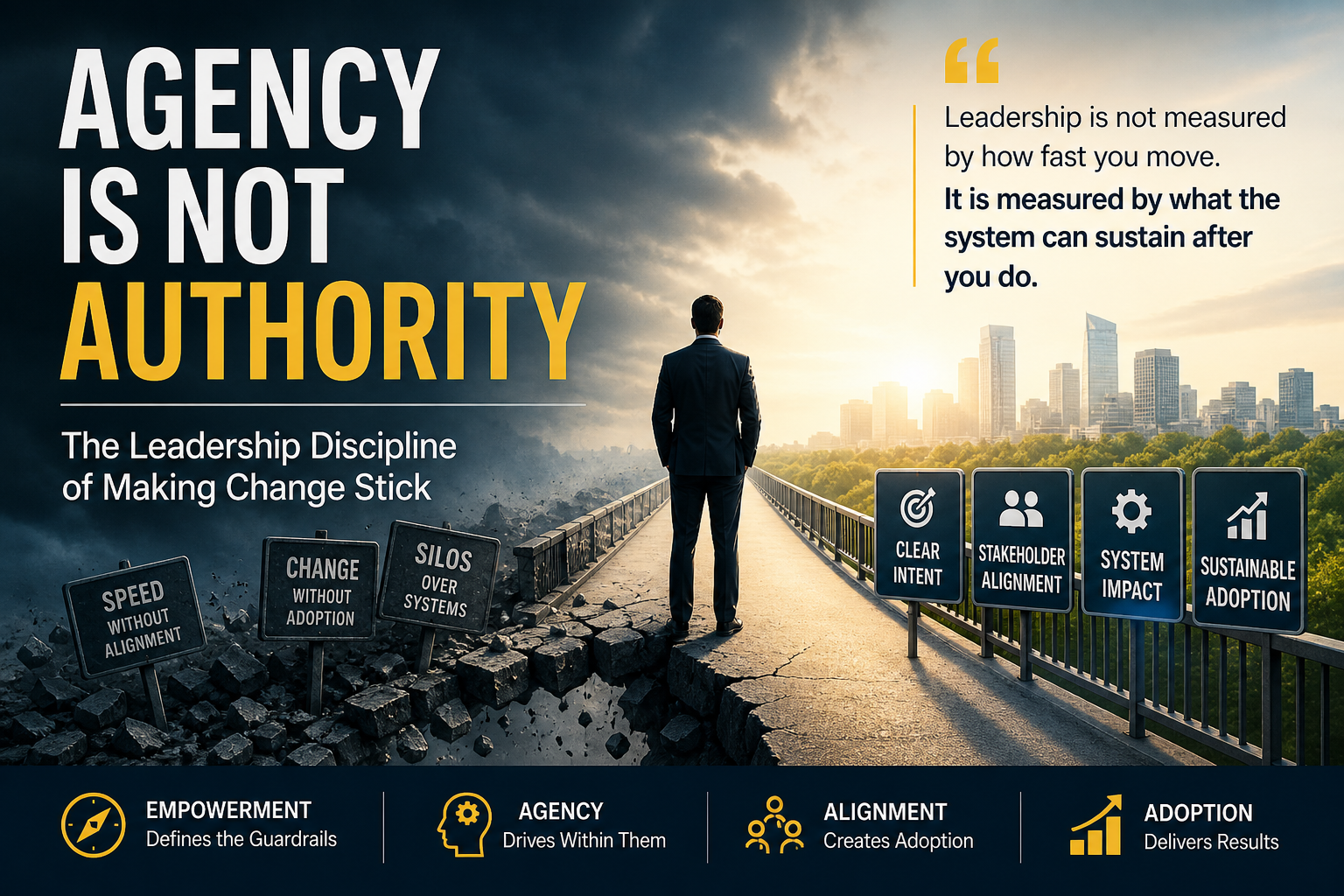
Agency without alignment is not leadership. It is disruption.
The Distinction That Actually Matters
At an executive level, the difference between empowerment and agency is not theoretical. It is operational, and it is something we have to actively teach.
Empowerment is granted. Agency is exercised.
Empowerment is structural. It is what the organization gives you:
- Clear scope of ownership
- Decision rights
- Access to resources
- Defined guardrails
It is designed into the operating model.
Agency is behavioral. It is how you choose to act within that structure:
- Judgment
- Timing
- Influence
- Accountability for outcomes
It is demonstrated through execution.
Where leaders get into trouble is when agency is interpreted as unbounded authority rather than disciplined action within context.
When Agency Becomes Operational Debt
High-performing operators are wired to move fast. Solve problems. Eliminate friction.
That strength, without calibration, becomes a liability.
- Speed without alignment creates rework
- Change without adoption creates shadow processes
- Local optimization creates system-wide friction
This is how well-intentioned leaders create invisible operational debt.
In my case, the process itself was not the issue. The orchestration was.
I had not fully accounted for:
- Stakeholder alignment across teams
- The organization’s capacity to absorb change
- Downstream impacts on adjacent workflows
- The behaviors required to sustain the new process
The system responded predictably.
It pushed back.
The Leadership Line: Control vs Progress
There is a fine line leaders must walk, and as leaders of leaders, we have to help others see it.
- Too much empowerment without agency leads to hesitation. Decisions stall. Everything escalates.
- Too much agency without structure leads to fragmentation. Teams move in different directions.
The balance is where real leadership lives.
Empowered boundaries. Disciplined agency.
I often frame it this way when coaching:
Empowerment defines the guardrails. Agency determines how you drive within them.
Strong operators do not bulldoze.
They sequence.
They understand that sustainable progress is not just about action. It is about absorption.
Coaching the Shift
When a leader asks how to show more agency, the answer is not “move faster.”
It is to think differently.
The shift is this:
Stop optimizing for speed of action.
Start optimizing for speed of adoption.
Because in operations, adoption is the only thing that matters.
The Agency Calibration Model
To operationalize this, I coach leaders to use a simple calibration model when driving change.
1. Clarity of Intent
Is this aligned to a broader organizational outcome, or is it locally optimized?
2. Boundary Check
What decisions are truly mine, and where do I need alignment?
3. System Impact Scan
Who and what does this disrupt downstream?
4. Adoption Path
How will this be understood, adopted, and sustained?
5. Paced Execution
What is the fastest path the organization can absorb without breaking?
This is where most leaders get it wrong.
They optimize for speed of action.
Instead of speed of adoption.
And in operations, adoption is the only thing that matters.
Quick Exercise for Leaders
Think about a change you are driving right now.
Who should be involved before this moves forward?
Now ask yourself:
Am I optimizing for how fast I can launch this, or how well it will actually stick?
If you are optimizing for speed, stop.
Go talk to your stakeholders about adoption.
The Hard Truth
Agency is not about forcing change.
It is about making change stick.
Because at scale, leadership is not measured by how fast you move.
It is measured by what the system can sustain after you do.
Final Thought
When a leader asks, “How do I show more agency?” the answer is not to do more.
It is to operate with greater precision.
Because the goal is not activity.
It is outcomes that endure.