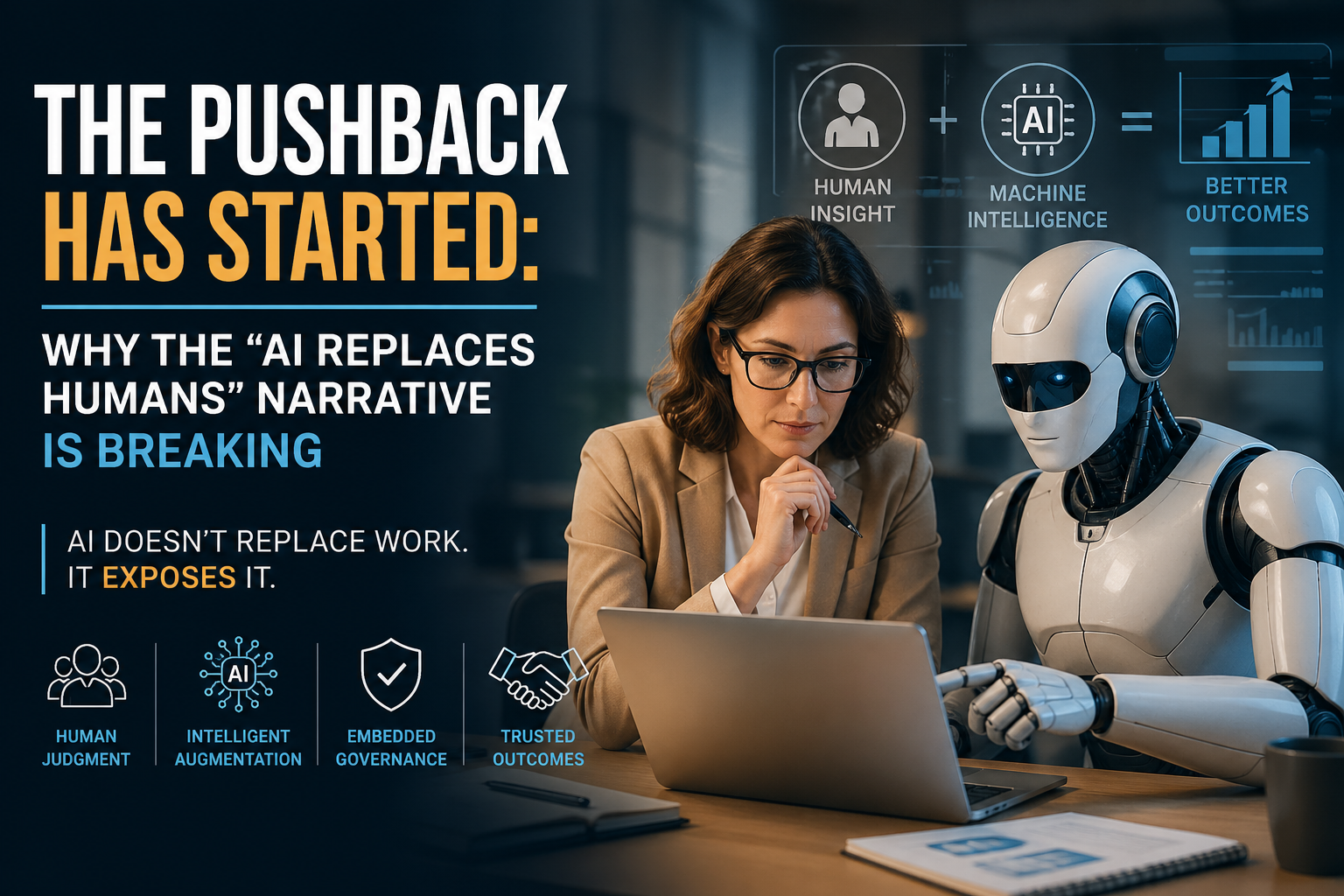
The narrative that AI will replace humans is starting to break.
And the people closest to the work are the ones breaking it.
Over the past several weeks, scrolling through LinkedIn and other platforms, the tone has shifted. What was once a steady stream of bold claims about removing humans from the equation is now being met with something different.
Pushback.
Not emotional resistance. Not fear.
Informed, experience-driven skepticism from operators who are actually responsible for outcomes.
What Changed
For the past two years, the dominant narrative has been simple:
- AI drives efficiency
- Efficiency reduces cost
- Cost reduction means fewer humans
On paper, it is clean. In practice, it is incomplete.
Research from McKinsey’s “Generative AI and the Future of Work in America” suggests that up to 60 to 70 percent of work activities can be augmented by AI, not fully automated. At the same time, Gartner research on AI project failure rates highlights that many initiatives fail to deliver value due to unclear use cases and poor workflow integration.
That gap is no longer theoretical. It is showing up in operations every day:
- AI deployed into unclear workflows creates inconsistency at scale
- Automation without context increases rework, not efficiency
- Removing human judgment too early erodes trust, not just experience
- Cost savings realized in one area reappear as risk, churn, or escalation elsewhere
This is where the pushback is coming from.
Where It Breaks in the Real World
In client operations, this becomes visible quickly.
A common pattern:
An organization deploys AI to handle high-volume support interactions. The intent is sound, reduce handle time, improve speed, lower cost.
But the workflow behind those interactions is not fully defined. Decision points are inconsistent. Context is fragmented across systems.
The result:
- AI generates fast responses, but not always the right ones
- Customers re-contact, increasing total volume
- Agents spend more time correcting than resolving
- Trust declines, even as “efficiency metrics” improve
On paper, the system looks optimized.
In reality, it is creating hidden operational drag.
This aligns with findings from Harvard Business School and BCG’s study on AI productivity, which show that performance improves only within clearly defined workflows.
Similarly, research from Stanford’s study on generative AI in the workplace shows that AI delivers the most value when augmenting human capability.
The Market Is Maturing
What we are seeing is not rejection of AI.
It is the beginning of discipline.
1. AI as a cost-cutting mechanism
Short-term gains, long-term instability
2. AI as an augmentation layer
Sustainable performance, scalable trust
The organizations leaning into the second are accelerating AI with structure.
The Operational Reality Most Missed
AI does not replace work.
It exposes how well work is designed.
This aligns with insights from MIT Sloan Management Review on AI and process design, showing that value comes from embedding AI into workflows, not layering it on top.
It is anti-undisciplined AI.
What Leaders Should Do Now
1. Redesign one workflow end-to-end
2. Reintroduce human judgment as a control layer
3. Embed governance into operations
This aligns with global frameworks like the OECD AI Principles, emphasizing human-centered design and accountability.
Final Thought
Have we designed work well enough for AI to scale it without breaking what matters most?
It is trust.